Back to News Feed
When Does a Curved Industrial Display Make Sense?
August 5, 2021
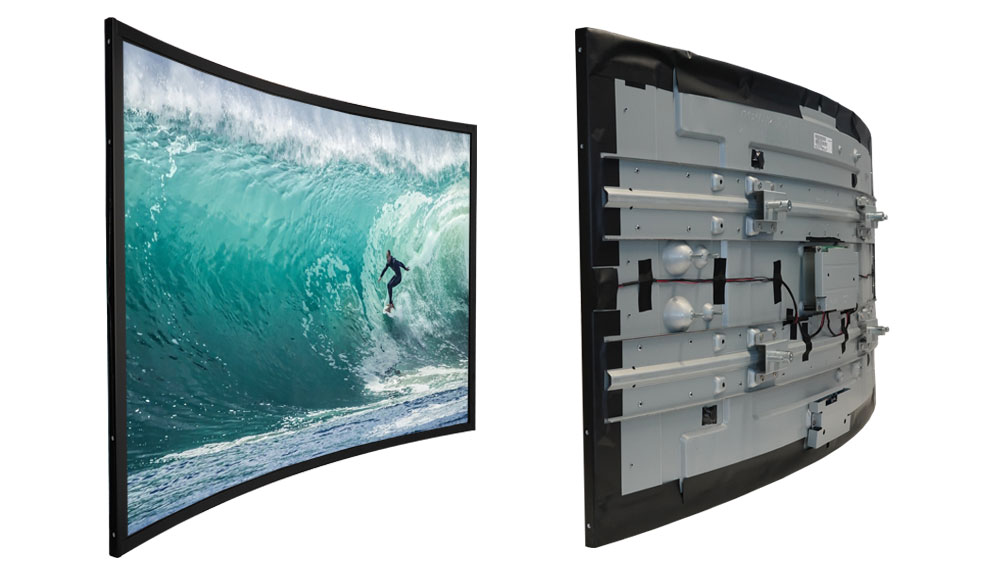
A curved industrial display makes sense when the image should feel deeper and the viewer needs to take in a large screen without losing the details at its edges: immersive HMIs, digital signage, and machines whose design is meant to stand out. FORTEC Integrated (formerly Distec), our sister company in the FORTEC Group, added 43-inch curved industrial displays from AUO to its range in 2021. We supply, integrate and support them from Ronkonkoma, New York.
Why does a curved screen read better?
Because the curvature follows the shape of the human eye. A curved monitor uses all three dimensions, which matches natural vision, so details at the edge of the screen are perceived more clearly and the image gives a deeper, more spatial impression. The curve brings the outer parts of the screen closer to the viewer’s peripheral field of view, and the panel’s stable viewing angle keeps the image undistorted, which makes viewing more relaxed.
Which curved display is available?
The P430QVR01.0, a 43-inch UHD display optimized for 24/7 continuous operation:
- 3840 × 2160 resolution and a curvature radius of 1500 mm.
- A matte VA panel with 4000:1 contrast and great color depth.
- 500 cd/m² brightness.
- A backlight lifetime of at least 50,000 operating hours.
- A V-by-One interface.
- Landscape or portrait mounting, and an operating range of 0 to +50°C (+32 to +122°F).
For flat 4K panels, see which 4K and UHD TFT displays are available for industrial OEM designs.
Where does a curved display fit?
In immersive HMI and digital signage systems, where the 43-inch UHD curve draws the viewer in. Mounted vertically, it allows distinctive three-dimensional designs, for example in vending machines. These are examples rather than limits: we design the display into whatever enclosure and installation the product requires.
Is there a curved touch version?
There was, and it is now discontinued. The P430QVT01.0 combined the 43-inch curved UHD panel with 10-finger touch and a 4.5 mm cover glass with a black frame print and anti-glare coating. Its product page names the P430QVR01.0 as the alternative, which has no touchscreen. If a design is built around the touch version, our obsolescence management helps plan the change.
How is it driven?
As a plug-and-play kit with our Prisma-4K TFT controller board, so the display can be commissioned quickly. Our post on how Prisma TFT controllers simplify display integration explains what the controller takes off the design team’s plate.
Tell us where the display has to go and what it has to show, and we will take it from there. We recommend the panel and controller, integrate them with the computer and power supply, and stay with the project from first samples to series production, backed by our technical services.