
Back to Blog
What Is COM-HPC, and When Do You Need It?
September 3, 2024
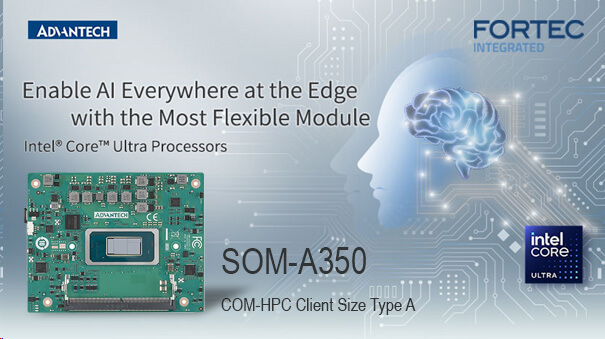
COM-HPC is the PICMG computer-on-module standard for high-performance computing. It does not replace COM Express; it adds a class of high-performance processor modules of up to 300 W above it, with its own connector, module types, and sizes. We supply COM-HPC modules and evaluation boards from congatec and Advantech through the FORTEC Group, and we integrate and support them from Ronkonkoma, New York.
When do you need COM-HPC rather than COM Express?
When the module has to deliver more power, memory, or bandwidth than a COM Express design provides. The modules in our catalog show where that line sits:
- Processor power: COM-HPC modules go up to 300 W.
- Memory: the server-type conga-HPC/sILH, with an Intel Ice Lake processor, takes four DDR4 DIMMs for up to 1 TB.
- I/O bandwidth: client modules such as the Advantech SOM-A350 offer PCI Express Gen5, USB4, and 2.5 GbE.
For lower-power designs, COM Express remains the standard: the conga-TC700 COM Express Compact module, for example, carries Intel Core Ultra processors with up to 96 GB of RAM. Moving to COM-HPC brings new engineering questions, from the connector and the choice of module type and size to cooling concepts and signal integrity, and those are the questions to settle with us early in the design.
What does a COM-HPC module with AI support offer?
Combined CPU, GPU, and neural processing on one module. The Advantech SOM-A350 is a size A COM-HPC client module with Intel Core Ultra Meteor Lake U/H processors, the first Intel platform with an integrated Neural Processing Unit (NPU). The system on chip reaches 32 TOPS of AI performance, which improves image quality and processing speed and reduces the need for an external graphics card in medical imaging, test equipment, and edge AI devices:
- Up to four independent 4K displays over HDMI, eDP, and DisplayPort.
- Up to 96 GB of DDR5 on 95 x 120 mm.
- PCI Express Gen4 and Gen5, SATA, USB, SPI, smart fan control, and 2.5 GbE.
How do you evaluate a COM-HPC module before designing a carrier?
On an evaluation carrier board that routes every module signal to standard connectors. We supply the Advantech SOM-DH3000 development board for client modules in sizes A (95 x 120 mm), B (120 x 120 mm) and C (120 x 160 mm), and congatec evaluation carriers for each module type: the conga-HPC/EVAL-Client, the conga-HPC/EVAL-Server and the conga-HPC/EVAL-Mini.
What if a module is more than the design needs?
Then a single board computer or motherboard may fit better. 2.5-inch Pico-ITX boards and 3.5-inch SBCs are mainly used in industrial applications, while Mini-ITX motherboards are common in digital signage. Our post on congatec computer-on-modules covers smaller SMARC modules and a Pico-ITX board.
Whichever platform fits, tell us what the system has to do, and we will take it from there. We help select the components, develop individual cables, adapt the BIOS, heatsink, and assembly variants, build a custom Windows operating system image, and deliver it all as one product, from first samples to series production, backed by our technical services.
Which Optical Bonding Material Is Best: Silicone OCA, Acrylic OCA, or LOCA?
October 15, 2026
How Do You Design a Display for Harsh Environments?
October 12, 2026
How to Choose an Edge AI Computer for a Medical Device
September 29, 2026
Embedded PCs vs. Consumer PCs: What’s the Difference?
August 31, 2026

How Hover Touch Technology Can Improve Industrial Interfaces
August 31, 2026

The Real Cost of Choosing the Wrong Display for an Industrial Product
August 28, 2026