Bringing AI to the Point of Care: Does Your Next Medical Device Need an NPU?
November 2, 2026
By Mike Pizzirusso, Head of Product Development, FORTEC US
Medical device makers are moving AI out of the cloud and into the device itself, and the NPU is the technology that makes it possible. Whether your next design needs one comes down to what it has to analyze, how fast, and where. The six-question check below answers that in about a minute.
Why Run AI on the Device Instead of the Cloud?
Because results arrive in milliseconds instead of seconds, patient data stays local, and the device keeps working when the network doesn’t. Those practical reasons are why more and more medical OEMs are running AI directly on the device, right at the point of care.
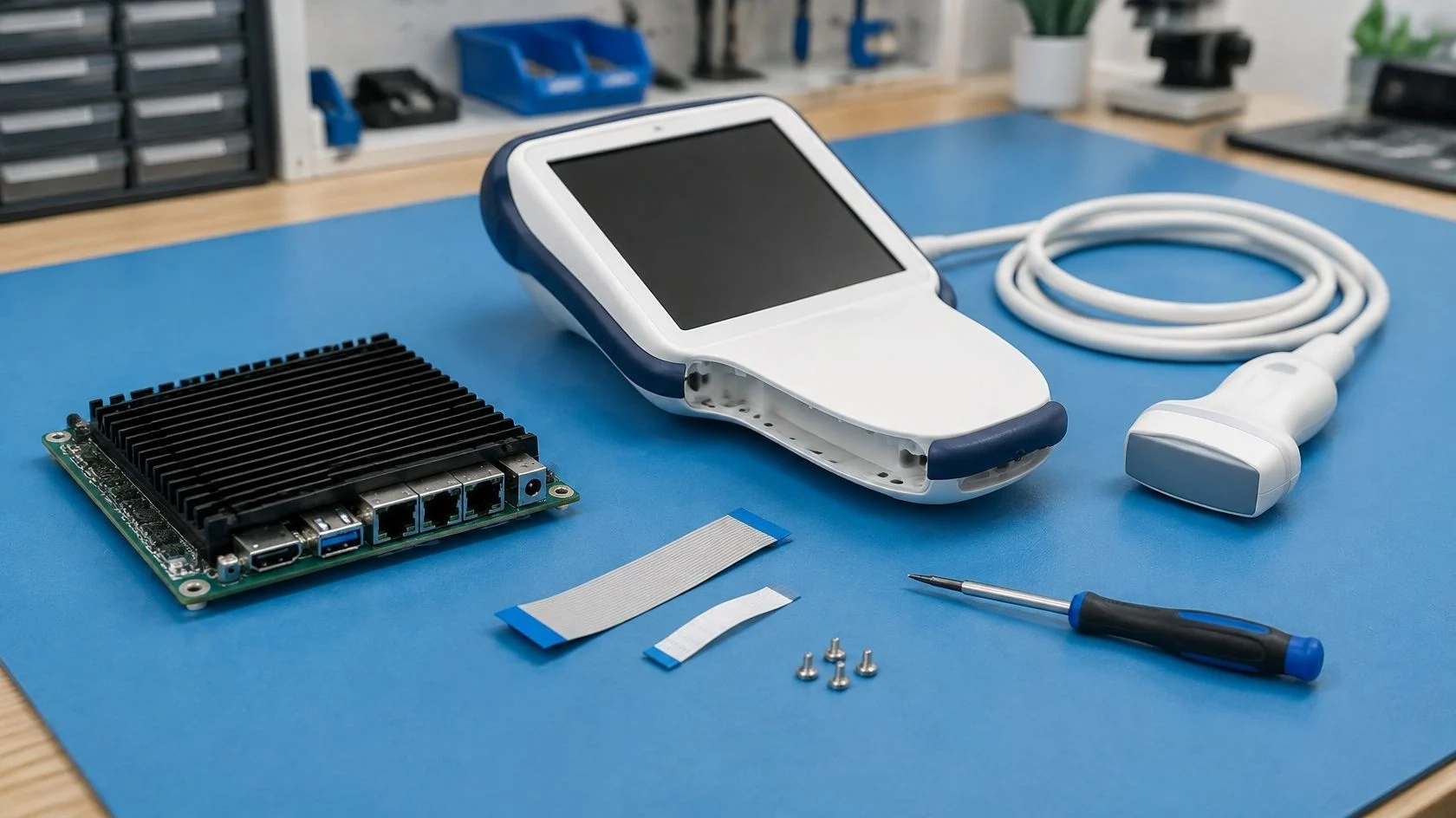
An NPU (neural processing unit) is a dedicated AI engine, now built into a new generation of single-board computers, such as the 3.5″ ASUS IoT Meteor Lake SBC, the 3.5″ ASUS IoT Arrow Lake SBC, and the Advantech AIMB-234. But an NPU is only an enabler. What matters is the clinical or workflow problem it helps solve. For what an NPU does inside a medical device and how to read its TOPS figure, see how to choose a medical edge AI computer.
Which Medical Devices Benefit From On-Device AI?
We see five areas where medical OEMs gain the most from an AI-capable SBC: medical imaging, patient monitoring, portable diagnostics, surgical guidance, and smart home-care devices. The table shows the typical devices in each and what local AI makes possible.
| Application area | Typical devices | What local AI makes possible |
|---|---|---|
| Medical imaging | Ultrasound, portable X-ray, endoscopy, ophthalmology, and dermatology | Real-time image enhancement, anomaly detection, organ segmentation, and guidance for technicians |
| Patient monitoring | Bedside and ICU monitors, wearable ECG, and ambulatory cardiac and glucose monitors | Arrhythmia detection, early warning of adverse events, and fewer false alarms |
| Portable diagnostics | Handheld ultrasound, point-of-care testing, and rural and emergency medicine | Immediate results with no cloud connection and minimal bandwidth |
| Surgical and procedure guidance | Robotic surgery, navigation systems, and procedure assistance | Low-latency image processing and instrument tracking, where milliseconds matter |
| Smart and home-care devices | CPAP, neurostimulators, remote monitoring, and rehabilitation | Therapy that adapts to each patient, with data processed on the device |
The common thread: each of these devices needs to make sense of images or physiologic signals quickly, privately, and reliably.
The 60-Second NPU Check
Answer these six questions about your next-generation product:
- Does it use cameras or medical imaging?
- Does it analyze ECG, EEG, EMG, or other physiologic waveforms?
- Are you adding predictive or diagnostic features?
- Do users need results in real time?
- Should patient data be processed locally rather than in the cloud?
- Will some deployments have limited or no internet access?
Three or more yes answers? Your product is a strong candidate for an NPU-equipped SBC.
When a Strong CPU and Graphics Are Enough
Not every medical device needs an NPU. HMIs, nurse stations, medical carts, connectivity gateways, and traditional instrument controllers are often well served by a strong CPU and graphics. We’ll tell you honestly which fits your project.
NPU FAQs
Does an NPU need a separate GPU or accelerator card?
No, an integrated NPU runs AI inference on the processor itself. Boards built on Intel Core Ultra or AMD Ryzen Embedded 8000 processors include one, in 3.5-inch SBC and Mini-ITX formats. Our guide to embedded boards that add an NPU or AI acceleration at the edge compares them.
What is the difference between an NPU and a GPU?
An NPU is built specifically to run AI models, and to run them efficiently at low power. Moving sustained inference onto the NPU leaves the CPU and GPU free for the user interface and data processing. It also helps with heat in a sealed or fanless enclosure.
How many TOPS does a medical device need?
That depends on the validated workload, not the headline figure. TOPS, trillions of operations per second, is a peak number that is useful for comparing platforms. Treat it as the ceiling, then confirm the real workload runs within the device’s power and thermal envelope.
What happens when an NPU board reaches end of life?
We tell customers early and plan with them. That means a last-time buy to cover remaining builds, or qualifying a replacement before supply runs out.
Let’s Talk About Your Next Project
We help medical OEMs choose the right embedded platform, from proven display and HMI systems to AI-ready SBCs with integrated NPUs. Whether you’re adding image analysis, waveform interpretation, or predictive monitoring, we can help you size the right solution early, before it’s locked into your design.
Bringing FORTEC US in at the design stage helps you avoid costly surprises later, when the AI workload meets the hardware it has to run on. Display, embedded computing, and power sit under one roof at FORTEC, so the computer, display, and power supply can be evaluated together from the start. That reduces integration effort and technical risk. For the rest of what we supply to medical OEMs, see medical displays, panel PCs, and embedded systems.
Planning a new embedded project? Contact FORTEC US for a no-obligation conversation about your requirements.
What Does the FORTEC Group Mean for US Customers?
October 30, 2026
Is FORTEC US a Distributor? What a Value-Added Display Supplier Does
October 29, 2026
Who Is FORTEC US?
October 28, 2026
Which Optical Bonding Material Is Best: Silicone OCA, Acrylic OCA, or LOCA?
October 15, 2026
How Do You Design a Display for Harsh Environments?
October 12, 2026
How to Choose an Edge AI Computer for a Medical Device
September 29, 2026