How Do You Make a TFT Display Readable in Direct Sunlight?
April 19, 2023
A TFT display stays readable in direct sunlight when the design combines enough backlight brightness, a liquid crystal that holds up in sun and heat, wide viewing angles, and brightness control that follows the ambient light. Polarized sunglasses add one more requirement that is easy to miss. Below is how the panels we supply handle each, from compact handheld modules to a 32-inch panel.
Why do some displays go dark behind polarized sunglasses?
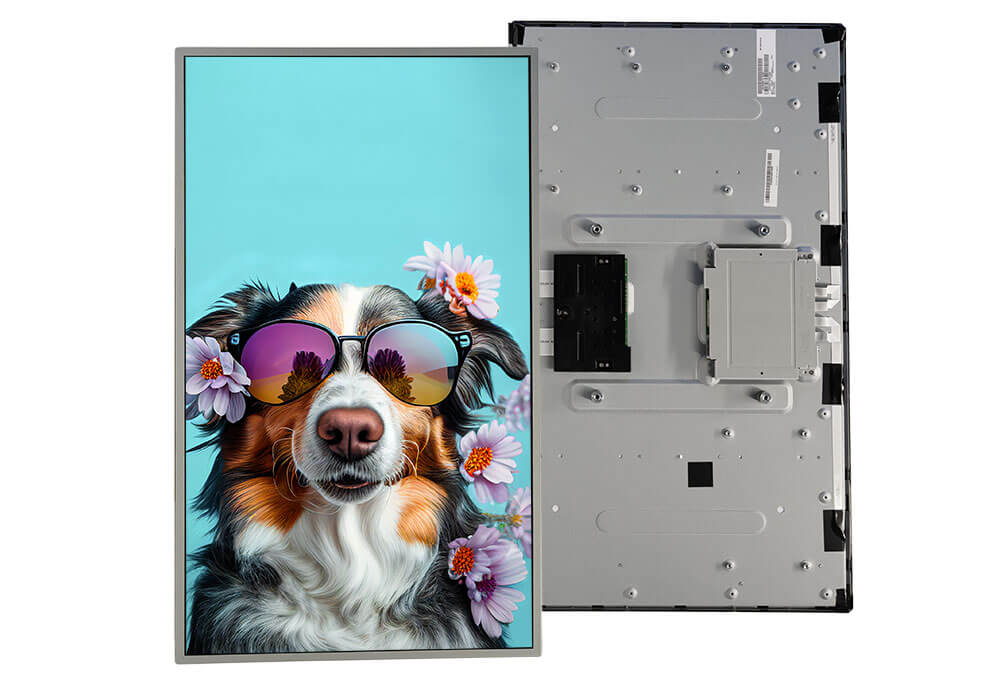
Because the display has polarizing filters of its own: at certain angles between the sunglasses and the display, the content is filtered out completely, and the operator has to tilt their head or take the glasses off. AUO’s 32-inch P320HVN04.5 is readable with polarized sunglasses without restriction in portrait mode. It pairs 1500 cd/m² brightness with a 4000:1 contrast ratio, a high-Tni liquid crystal for sunlight, and A-MVA wide-viewing technology for readability from the sides.
Is a brighter backlight always better?
No. A backlight set for midday sun dazzles in dim light, and running it at full brightness costs power, heat, backlight lifetime, and, in portable devices, battery life. Sunlight-readable designs therefore dim with the ambient light. The P320HVN04.5 dims from 0 to 100%, automatically when it runs on our Prisma TFT controllers with a brightness sensor: the sensor measures the ambient light, and the controller sets the display brightness to match.
The 18.5-inch G185HAN01.0-1000 is built the same way. It is based on AUO’s G185HAN01.0 with an improved LED backlight that raises it to 1000 cd/m², with a full HD resolution, a symmetrical 89° viewing angle in all directions, and an operating range of -20 to +70°C. As a plug-and-play kit it comes with a controller board, an LED converter, and a light sensor, and it dims between 0 and 100% as the light changes, which also reduces heat compared with running at full brightness. More on the controllers is in how Prisma TFT controllers simplify display integration.
Is there a sunlight-readable display that uses less power?
Yes. ORTUSTECH’s New Blanview technology keeps a display readable in direct sunlight without raising the brightness, at up to 60% lower power consumption than a conventional transmissive TFT. The COM43H4N44ULC uses it, with a typical brightness of 550 cd/m², a backlight lifetime of 50,000 hours to half brightness, an operating range of -30 to +85°C, vibration resistance up to 6.8G, and a weight of 58 g. That suits handheld devices and construction, agricultural, and maritime equipment.
ORTUSTECH displays are now reaching end of life: Toppan is ending all of its LCD production, and the last-time buy closes at the end of October 2026. If one is designed into a product you still build, see our ORTUSTECH last-time buy notice.
Which earlier high-brightness panels are discontinued?
Two panels from this class are end-of-life: the 12.1-inch GKVGC1MNDK2A0 from Solomon Goldentek (1280 x 800, 1300 cd/m², a 176° symmetrical viewing angle, -20 to +70°C) and the 10.1-inch AL101WXL02-N (1280 x 800, 1300 cd/m², 800:1 contrast, a 170° viewing angle, -20 to +70°C). If either is in a product you still build, give us the part number and we will find a replacement.
Where does optical bonding fit in a sunlight-readable design?
Bonding the touchscreen or protective glass to the panel removes the air gap between them, which reduces the reflection of incoming light and raises contrast without raising power consumption. We do it in-house in Ronkonkoma with VacuBond® optical bonding, and the benefits of optical bonding go beyond readability.
Tell us where it has to work, and we will take it from there. We recommend the panel, pair it with the controller, light sensor, touchscreen, and cover glass, bond the assembly, and stay with the project from first samples to series production.