
Can a PCAP Touch Screen Work With Gloves and Water on the Glass?
October 20, 2020
Yes. A projected capacitive (PCAP) touch screen can work with gloves on the operator’s hands and water on the glass, as long as the touch controller is adapted to the sensor, the cover material, and the conditions. FORTEC Group engineers have shown it through a 4 mm acrylic cover, with heavy work gloves, under running water.
Why is glove touch through acrylic harder than through glass?
Because a PMMA (acrylic) pane shields the PCAP signal much more than a glass pane of the same thickness. In industrial areas a touch screen has to resist dirt and moisture and still be easy to operate with gloves, some of them very thick, and an acrylic protective pane makes that harder still. Our engineers studied the problem in depth and adapted the touch controller to it.
In the demonstration, a DITO touch sensor behind a 4 mm PMMA protective pane was operated under the direct influence of water with ESD gloves, leather gloves, and an industrial standard glove worn together with a chain-mail glove of the kind used in meat processing. The touch worked in every case and registered no false events, even when wet.
How does a touch screen tell water from a finger?
Through water detection in the touch controller. Without it, rain or spray can cause malfunctions, because the controller reads the conductive water as an input, which hinders outdoor use. Two approaches handle it:
- Distinguish the droplets from the real touch, so operation continues while the glass is wet. This is what the controller in our glove demonstration does.
- Detect the water and reject all inputs above a set threshold until it is wiped off, then resume normal operation. DMC introduced this as an option for its DUS-series PCAP touch screens, which we also supply (for example the DUS-057B060A). The controller reports the protection mode to the host over USB, so the application can show a warning on screen.
What does a rugged PCAP touch panel look like?
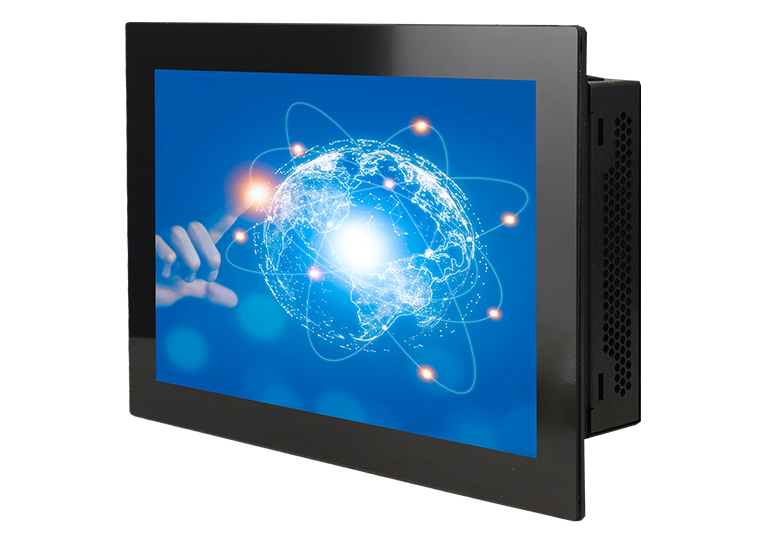
One example from the FORTEC Group’s touch competence center is the 12.1-inch TP-DD1210-A07:
- 10 touch points behind a 1.1 mm cover glass.
- An operating temperature range of -40 to +85 °C, so it can also be used outdoors.
- A chip-on-flex touch controller with both I²C and USB interfaces.
- Water and palm detection that separates water drops and palm contact from real touch events, avoiding false inputs.
- Glove operation, and a glass surface that cleans quickly with common glass cleaning agents.
That combination suits industrial applications and public areas. Where an application needs even more robustness, we bond an additional protective glass to the touch screen with VacuBond® optical bonding, done in-house in Ronkonkoma, New York. The bond increases shock and vibration resistance while keeping the optical properties of the touch display unit. More PCAP options are on our PCAP technology page.
Where do you start with a demanding touch application?
With the environment: the gloves, the liquids, the cover material, and the temperatures the screen will see. For how those conditions shape the rest of the display assembly, see how do you design a display for harsh environments? and integrating touchscreens into harsh environments.
Tell us where it has to work, and we will take it from there. We tune the touch controller to the sensor and the cover, bond the assembly, source through the FORTEC Group, and stay with the project from first samples to series production.