Why Do Public Buildings Need Fire Protection Class A1 Monitors?
November 4, 2019
Because the monitors that guide visitors through hospitals, universities, schools, airports, and the public areas of buildings often hang in escape and rescue routes, where fire rules restrict what may be installed. A standard monitor there usually needs a separate fire protection enclosure. BLO-Line® (Blaze Load Optimised) monitors are classified in fire protection class A1, the non-combustible class, so they can be installed without one. The series is developed by FORTEC Integrated, our sister company in the FORTEC Group, and we supply, integrate, and support it from Ronkonkoma, New York.
What does fire protection class A1 mean?
It means the product is not flammable: in a fire it gives off no or little flue gas and produces no flaming droplets or falling parts. A1 is the highest class of EN 13501-1, the European classification of construction products and building elements by their reaction to fire, and the same class that applies to brick, steel, and concrete. The class below it, B-s1, d0, means difficult to ignite, with hardly any smoke and no flaming droplets or particles.
There is no equivalent standard for monitors, so BLO-Line monitors are tested as building products, using the single burning item (SBI) method of EN 13823. In the fire test the device is exposed to open fire for 30 minutes while its flue gas emission is measured, and a publicly appointed and sworn fire prevention expert draws up the expert report. Every monitor ships with a certificate confirming its fire class.
What does a European fire class mean for a US project?
It gives the design team measured evidence, not a US listing. EN 13501-1 is a European standard, and the BLO-Line certificate states a European class. US projects are governed by US building and fire codes with their own test methods, so whether a European classification satisfies a given installation is for the project’s fire protection engineer and the authority having jurisdiction to decide. The certificate and the expert report give them the test data to make that call.
How is a BLO-Line monitor built to stay out of a fire?
By keeping fuel, air, and ignition sources out of the design:
- Materials with a low fire load, so the monitor does not feed a fire that starts elsewhere in the building.
- A construction that leaves hardly any free space inside the housing for air that would support a fire.
- A thermal fuse that disconnects the monitor from power in extreme heat.
- An optional extinguishing cartridge, triggered by a fire inside the monitor, that suffocates a flare-up.
The risk is real. In January 2021 a fire destroyed a motorcycle museum at the Timmelsjoch pass in the Alps, and the Tyrolean police traced it to a technical defect in the area of a presentation monitor. Monitors left running unattended are exactly where this kind of fire starts.
Does a BLO-Line monitor need a fire protection enclosure?
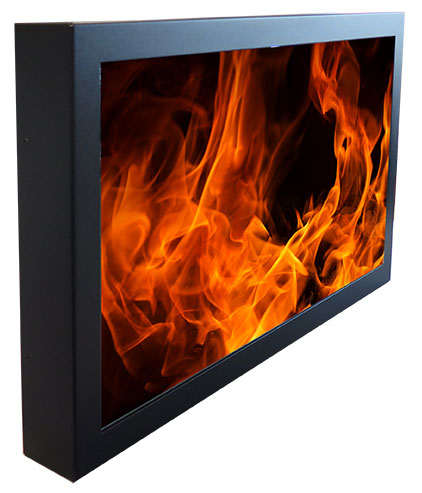
No. The monitor itself carries the classification, so the heavy enclosure falls away. A BLO-Line monitor weighs about half as much as a monitor in a fire protection housing, takes up much less space, and installs in four steps: mount the wall bracket, hook in the device, connect the cable, and fix the monitor. It mounts flush with the wall in portrait or landscape orientation, and a front frame with a cable bushing is available where the connections cannot sit directly behind the monitor.
Can a fire-rated monitor have a touchscreen?
Yes. Fire protection glass used to stop a PCAP touch sensor from working, and enclosures ruled touch out altogether. Working with its glass partners, FORTEC Integrated brought PCAP touch and fire protection glass together in 2020, and the touch version passed its own fire test and was certified to class A1. Today the 24-inch and 31.5-inch models are available with 10-finger touch.
Which BLO-Line monitors are available?
Three sizes, each with a choice of controller. IQ models have a built-in Intel® Atom PC. PME models use our in-house PrismaMEDIA-eco TFT controller with VGA, HDMI, and DisplayPort inputs for an external source.
- 24 inch: BLO-Line 24 IQ and BLO-Line 24 PME.
- 31.5 inch: BLO-Line 31.5 IQ and BLO-Line 31.5 PME.
- 46 inch: BLO-Line 46 IQ and BLO-Line 46 PME.
Options include the extinguishing cartridge, the front frame with cable bushing, and a barcode scanner. The larger sizes the series once covered, up to 64.5 inches, are discontinued.
The BLO-Line grew out of the first fire load optimized monitors in 2015, a POS-Line version classified B-s1, d0, whose fire load ran from 30.20 kWh at 31.5 inches to 45.67 kWh at 54.6 inches. The German Patent and Trademark Office granted the design utility model protection in 2017, the A1 series followed in 2019, and BLO-Line became a registered trademark in 2022.
How do we take a fire-rated display project from here?
Tell us where the monitor will hang and what it has to show, and we will take it from there. We recommend the size, controller, and touch option, supply each monitor with its fire class certificate, and stay with the project from first samples to series production. When a part receives an end-of-life notice, we tell our customers early and plan with them: a last-time buy to cover the remaining installations, or qualifying a replacement before supply runs out. Contact FORTEC US to start.