What Has VacuBond Optical Bonding Proven in Testing?
September 6, 2018
VacuBond® optical bonding has passed railway shock and vibration testing, 100 temperature cycles between -40 and +80°C, 504-hour climate soaks, and real impacts in a public installation. The FORTEC Group developed the process in Germany in 2013, and it has been available from FORTEC US since 2014. We run it in-house in Ronkonkoma, New York, bonding displays up to 32 inches with any touchscreen or cover glass. For how the dry vacuum process works, see What is VacuBond® Technology? This article covers what bonded units have proven.
What tests have VacuBond-bonded displays passed?
VacuBond units have passed shock, vibration, and climate testing in customers’ own test laboratories, in railway, agricultural, outdoor terminal, and public-access applications. These are the results recorded from those projects:
| Test | Standard or condition | Bonded assembly | Result |
|---|---|---|---|
| Railway shock and vibration (2018) | DIN EN 61373, Category 1, Class B; meets the IEC 60571 requirements for electronic equipment on rolling stock | 10.4-inch display bonded to the rear of a milled bezel carrying a glued touchscreen | Passed at the customer’s premises |
| Vehicle shock and vibration (2015) | IEC 60721-3-7, Classes 5M1, 5M2, and 5M3 | 10.4-inch high-brightness display bonded to 4 mm chemically tempered glass, glued into an agricultural machine’s dashboard with no screws | Passed without problems |
| Temperature cycling (2015) | 100 cycles between -40 and +80°C | 7-inch and 15.4-inch displays bonded to glass/glass touchscreens for outdoor terminals | Bond passed with no defects |
| Climate approval (2016) | DIN EN 60068-2-1 (Ab) and 60068-2-78 (Ca): 504 hours each at -40°C, +80°C, and +60°C at 95% humidity | 7-inch and 15.4-inch outdoor displays with bonded touchscreens | Passed |
| Temperature change (2016) | DIN EN 60068-2-14 (Nb): 100 cycles of 30 minutes at -40°C, a 10 K per minute ramp, and 30 minutes at +80°C | The same 7-inch and 15.4-inch units | Passed |
| Early qualification (2014) | Drop-ball tests for public terminals, railway approval test runs, IEC 60721-3-7, and MIL-STD-810F | Bonded display assemblies | Passed |
What failed in the temperature-cycling test?
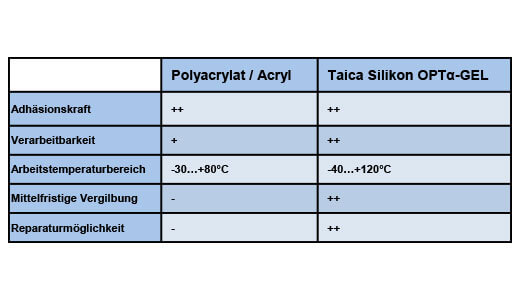
The panels failed, not the bond: after 100 cycles between -40 and +80°C, the internal polarizer of the TFT panels deformed and partly detached, while the VacuBond layer showed no defects. The material is the reason. We bond only with silicone OCA, rated from -40 to +120°C, where the acrylic materials we tested cover -30 to +80°C and cannot fully span a display rated for -40 to +85°C. Silicone OCA also does not yellow, and a bonded unit can be separated so that the display or touchscreen can be repaired or replaced on its own. The full comparison is in which optical bonding material is best.
Does optical bonding protect a display against vandalism?
Yes, and one of our own US projects showed how far. In a customer application, the display took impacts severe enough to bend its frame behind a 3 mm chemically hardened protective glass. The bond delaminated, but the glass did not chip. The silicone layer buffers impact energy and lowers the risk of glass breakage, and if the glass does break, it holds the fragments together and reduces the risk of injury.
Why do bonded assemblies survive shock and vibration?
Because the silicone layer counteracts vibration resonances and dissipates shock energy to the sides. Bonding can also replace screws. In the agricultural project above, the protective glass would usually be glued into the housing and the display screwed in separately, and the two fixings created tension against each other. Bonding the display to the glass, and the glass to the dashboard, removed those competing tolerances.
How has VacuBond grown since 2013?
- 2013: the FORTEC Group develops VacuBond in Germany.
- 2014: an identical VacuBond system is installed in Ronkonkoma, so production can move across the Atlantic if either site is hit by water, fire, or power failure. Displays from 2.4 to 24 inches are bonded with resistive, glass/glass, AMR, or projected capacitive touchscreens and toughened or PMMA cover glass.
- 2015: two larger machines, one in Germering and one in Ronkonkoma, raise the maximum size to 32 inches.
- 2017: a third production site opens in Pilsen, Czech Republic, and Ronkonkoma adds another system.
- Today: ultra-thin displays with or without bezels, the bare TFT cell, round displays, and E-Ink displays, plus void exclusion bonding, which fills the air spaces inside a display for explosion-protected (ATEX) areas.
How do you get a bonded display qualified for your product?
Bring us in at the design stage, with the tests your product has to pass. No design is too custom for us: tell us where it has to work, and we will take it from there. We recommend the display, touchscreen, and cover glass, bond the assembly with VacuBond optical bonding in Ronkonkoma, and stay with the project from first samples to series production. Qualification in your own device remains your test, and the results above show what bonded units have passed in the same position.