What Does the FORTEC US Quality Control Team Do?
November 24, 2026
By Talisa Westford, Marketing Executive, FORTEC US
At FORTEC US, our quality control team inspects displays and kits on the way into our facility in Ronkonkoma, New York, and on the way out. They also check the work at set points during the build, and sign each assembly off against its drawing before it ships.
Who Is on Our Quality Control Team?
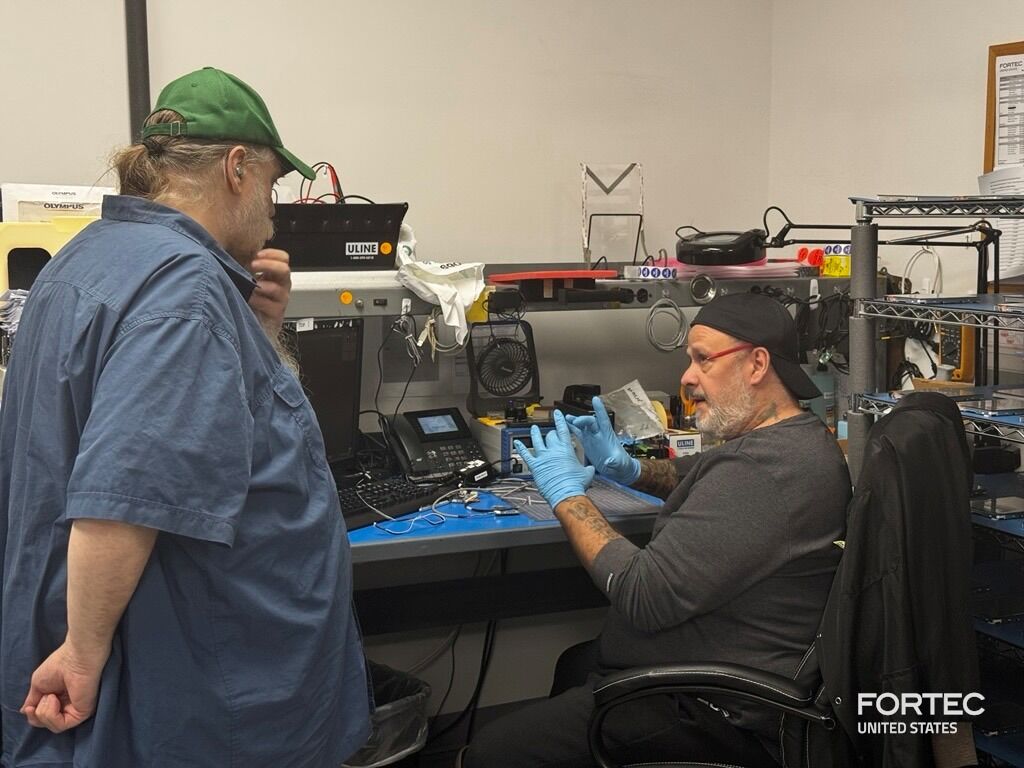
Doug Ackert and Brian Gollob inspect our work. They work mainly with engineering and production.
- Doug Ackert, Quality Control Inspector: more than 25 years at FORTEC. He started in soldering, moved into quality control as the company grew, and learned the industry and the process here.
- Brian Gollob, Quality Control Inspector: at FORTEC since 2021. He worked on the production floor first, moved into quality control in the last year, and still works in both as needed. He handles most of our incoming inspections.
What Does Quality Control Check?
Our inspectors check form, fit, and function: every assembly has to work properly and look good. Doug looks at each one from the customer’s side, and he aims to go beyond what the acceptance guideline asks for. Brian asks the people building each assembly to treat quality control as their customer:
“I always tell the team to look at Doug and me like we’re the customer.”
Brian Gollob, Quality Control Inspector, FORTEC US
There is no single standard for every job. Each assembly is checked against written acceptance criteria that look at the type of defect, its size, and how close it sits to other defects. The customer’s drawing comes first.
Our quality management system is certified to ISO 9001:2015 (certificate US3606) for the design and manufacture of display systems here.
What Does Incoming Inspection Check?
We audit displays as they arrive, and again on the way out, for defects caused by the manufacturer or by us. Each check starts from the part number and its drawing, and sometimes a work instruction. The drawing usually shows whether the part has been tested yet, which decides whether it needs testing here.
Incoming orders are sampled using AQL sampling. We inspect a sample that depends on the size of the order, for example 10 to 20 pieces out of 100. When a job requires 100% inspection, we check every piece.
Incoming glass and touchscreens are plugged in and measured. We check that a touchscreen works, with no dead lines and full functionality, and measure it to confirm it is the right size. We check the cable and look for cuts, debris, and broken corners. Once it passes, it goes on the shelf.
Parts bonded at one of our other FORTEC facilities are measured against a spec, and a part is used only if it meets it. When a manufacturer sends displays that arrive dirty, they are cleaned, which can make cleaning one of the longest steps in a job.
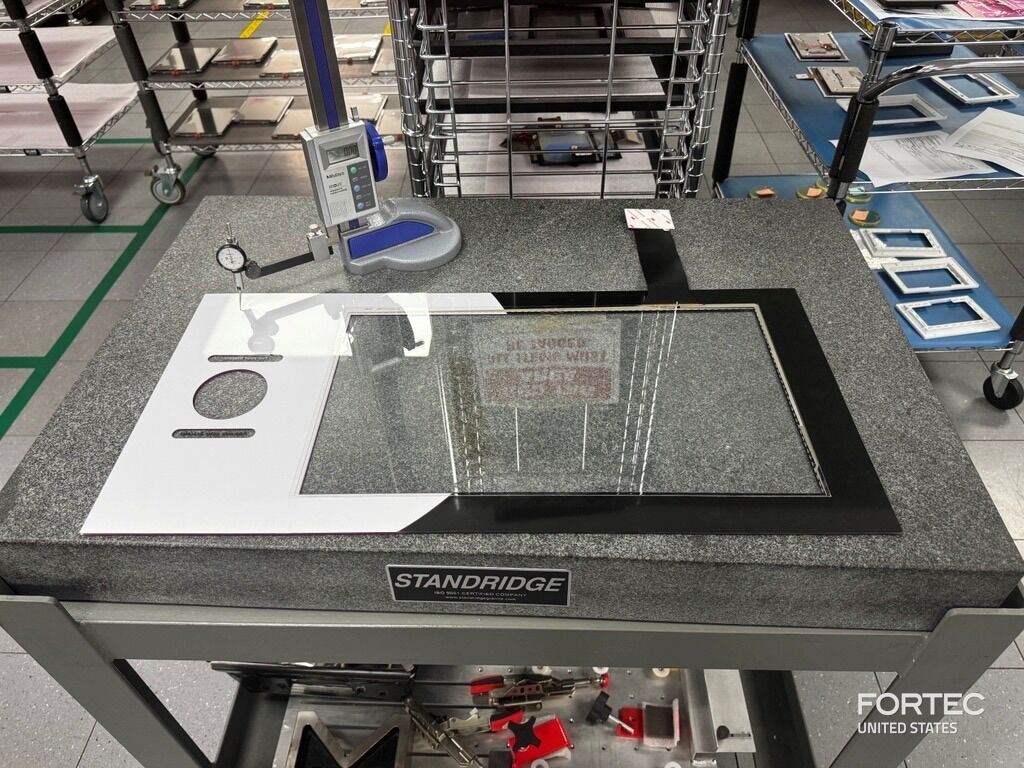
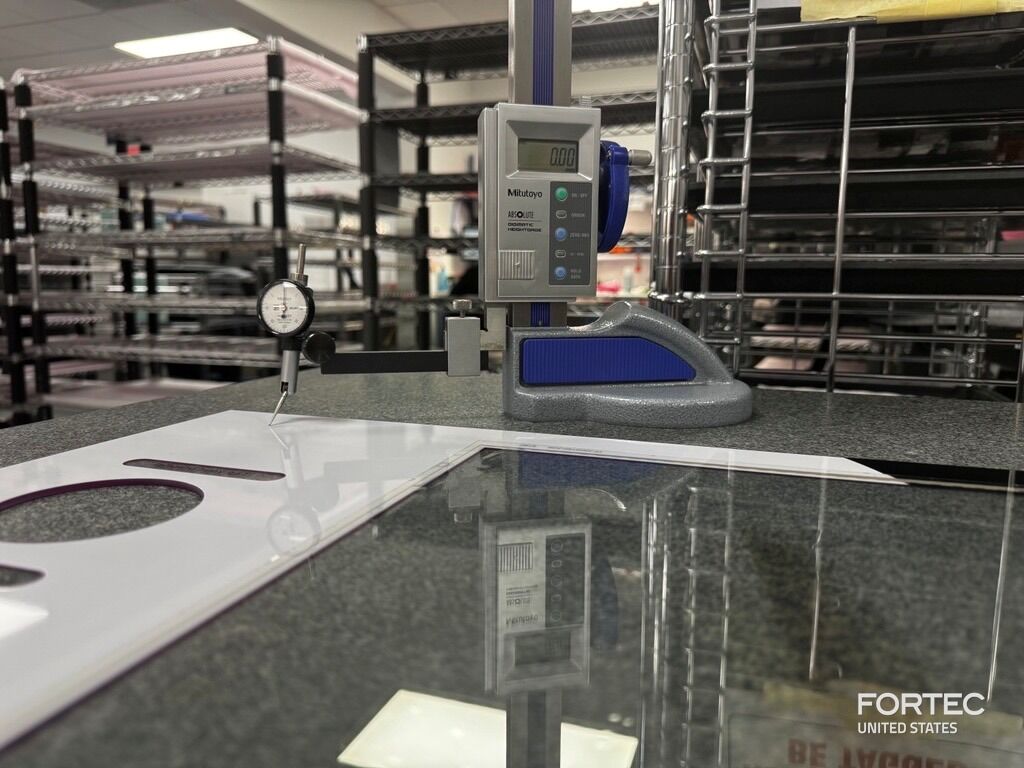
Glass is checked for flatness before it is bonded. Optical bonding needs the material to be extremely flat, and some glass has a slight bend or warp the human eye can’t detect. We lay it on a flat stone and use gauges to test for space under the glass.
How Is a Display Assembly Inspected During the Build?
We inspect a display assembly at set points during the build, before it moves on to the next stage. The stops are:
- Before assembly: some jobs need a first article inspection before our production team begins assembly.
- During assembly: partway through, the assembly comes to quality control.
- After the production jig: the assembly comes back to quality control to verify its dimensions and orientation.
Between these checks, our production team assembles the layers and lines them up in the jig.
Alignment is a large part of the check after the jig. The touchscreen is usually bigger than the display, so it overhangs it. It can’t shift a millimeter in any direction, or the assembly may not fit the application.
Checking at each stage finds a defect before the kit is built. Found later, the whole kit has to be taken apart, especially when it has a metal bezel, and the material is wasted.
Is the Bond Tested Before a Display Ships?
Yes, we stress test the bonding before shipment. Our inspectors also check each bonded display before it goes back to Robert Opitz, our Lead Bonder, which leaves him more time for repairs. By the time a display reaches him, usually nothing more needs to be done. If there is a discrepancy, he schedules the time to fix it.
That care and checking happens where the customer doesn’t see it. As Robert puts it:
“The customer may not really know what it takes to get that touch screen adhered to the display… There’s a lot that goes into it and that process.”
Robert Opitz, Lead Bonder, FORTEC US
How Is Foreign Object Debris Kept Out of an Assembly?
We keep foreign object debris (FOD) out of an assembly by stopping it at its sources: packaging, tape, and gaps. Parts are unpacked in the warehouse, not in the production area, so packaging debris stays out.
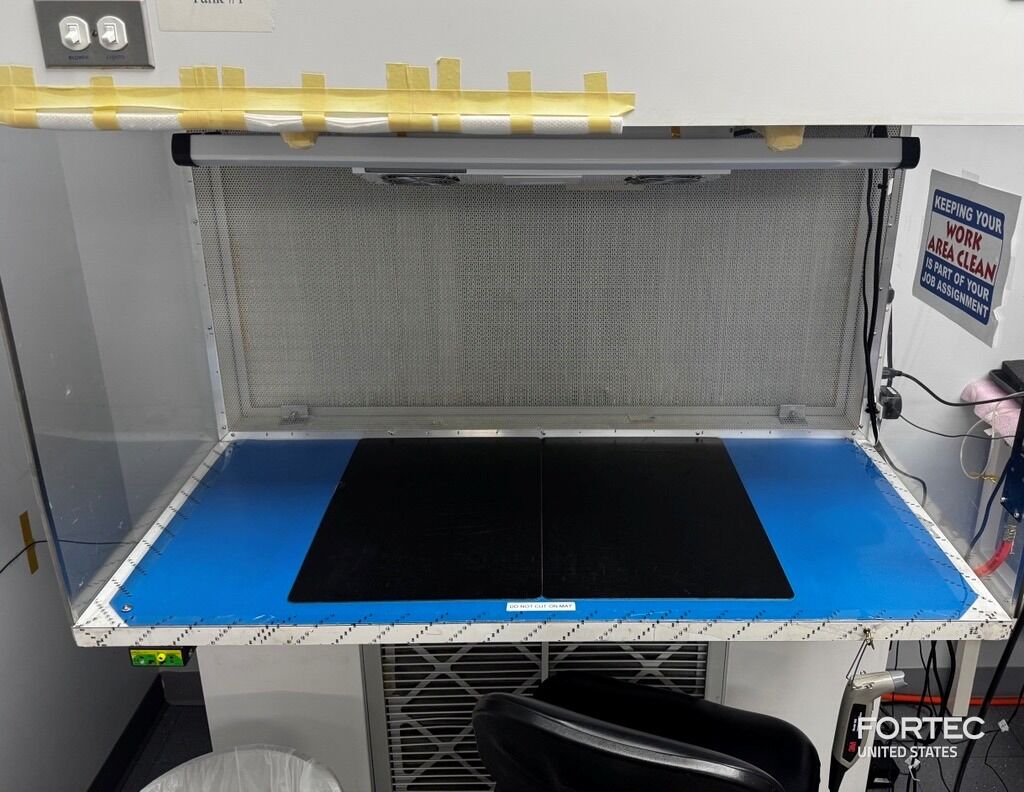
Tape is another source. As some tape liners are peeled away, they crumble, leaving bits of paper or thread behind. We do our taping under laminar flow hoods in the assembly room to keep FOD out.
Even a simple rectangular assembly needs its corners to meet. Where they don’t, the gap can let FOD in.
What Happens at Final Inspection Before an Assembly Ships?
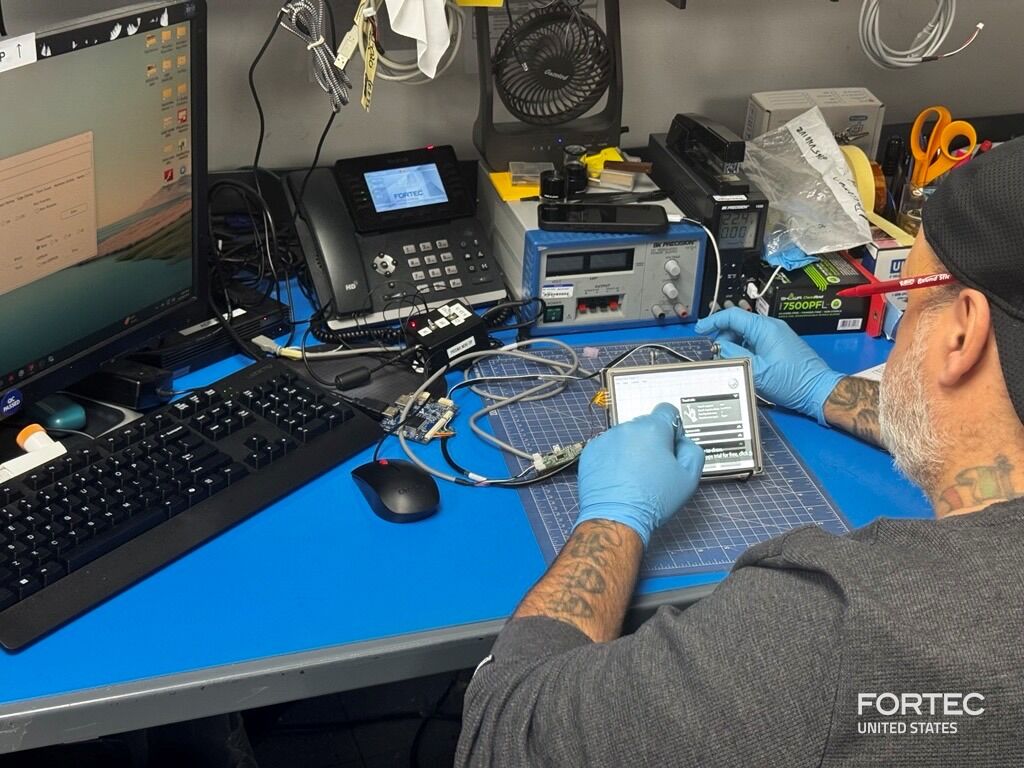
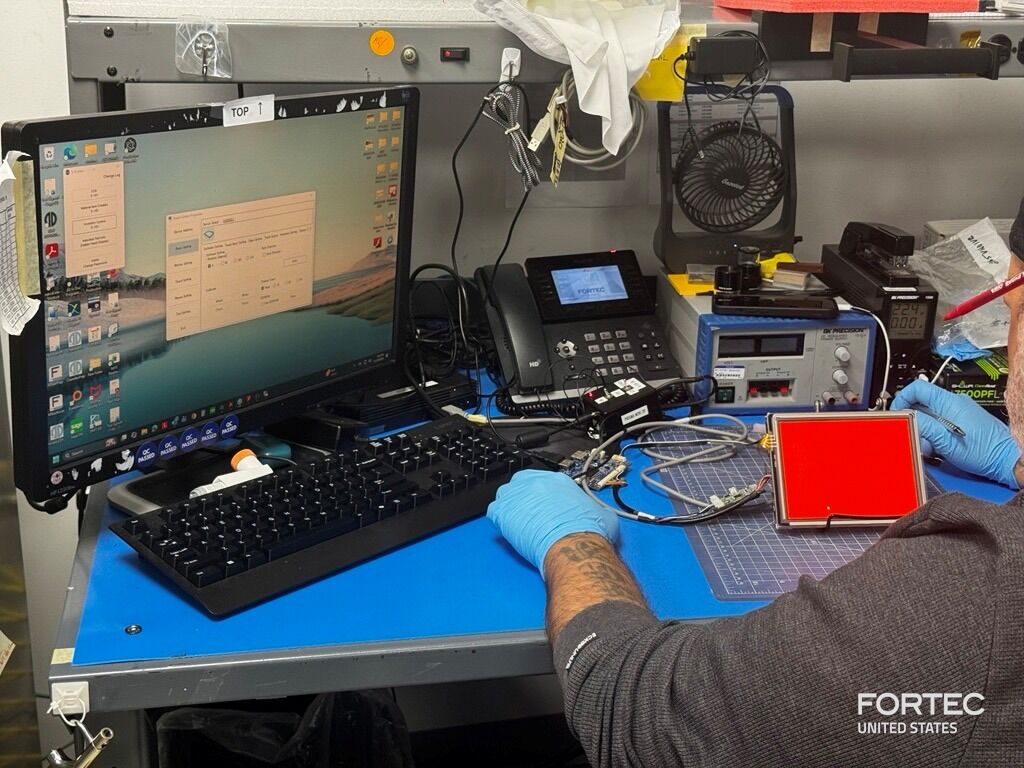
Before an assembly ships, our inspectors audit it against its drawing, and every job gets a visual check. We plug the assembly in to test its functionality, show colors on it to check for pixelation, and draw from corner to corner to test the touch. It has to look crisp, with nothing broken and no FOD or dirt.
Then the count is checked: an order of 10 displays and 10 cables has to have every item accounted for. Our production team checks the count first, and our inspectors confirm it. Once the paperwork is completed, the products move to the shipping area, where the warehouse packages them and our operations team arranges the freight.
What Happens When a Display Assembly Fails Inspection?
When an assembly fails inspection, we write a report on the defect and act on its cause. If we caused it, we fix it and take steps so it doesn’t happen again. If the manufacturer caused it, the report goes to the manufacturer, and our operations team takes the part back to the vendor.
The fails we find include:
- Bonding: delamination and bubbles.
- Display: FOD and debris.
- Production: a touchscreen off center.
- Glass: an occasional cut.
- Hardware: missing parts, such as screws.
Quality Control FAQs
How much of an order does FORTEC US inspect?
Every job gets at least a visual check, and incoming parts are sampled unless the job calls for 100% inspection. The drawing decides what else is tested, including whether a part was already tested before it reached us.
What is first article inspection?
It is a quality control check that some jobs need before production goes further. Here, it comes before our production team builds the assembly, so a problem is found before the rest of the job is built on it.
What is FOD in display assembly?
FOD stands for foreign object debris: anything inside an assembly that shouldn’t be there. Packaging debris and bits of paper or thread from tape liners are typical sources, and FOD is one of the common reasons a display fails inspection.
Can a bonded display be reworked?
Yes, a failed bond can be removed, but it is possible rather than routine. The bonded display is fastened to the table, and a wire like fishing line is run through the bond by shimmying it. It is a messy process that shreds the silicone OCA and takes a lot of alcohol to clean up.
Tell Us What the Assembly Has to Meet
Send us the drawing and what the assembly has to meet, and we will take it from there. We check the parts as they arrive, inspect the build at each stage, and sign each assembly off against your drawing before it ships from Ronkonkoma. Email info@fortec.us or contact FORTEC US to start.
Cincon CFM500 Power Supply: Up to 500 W in a 3 x 5-Inch Footprint
November 23, 2026
What Does the FORTEC US Engineering Team Do?
November 19, 2026
What Does the FORTEC US Operations Team Do?
November 17, 2026
DDP520 Power Supply: 340 W Without a Fan in a 3 x 5-Inch Footprint
November 16, 2026
Which PCAP Touchscreen Construction Fits Your Design: Glass/Glass, Glass/Film, or Film/Film?
November 4, 2026
Which Industries Does FORTEC US Serve?
November 3, 2026