Which 5G Routers Suit Industrial and Railway Connectivity?
November 27, 2024
The right 5G router depends on where the equipment sits: a stationary site with many connected devices, a vehicle on the move, or a rail vehicle that needs certified hardware. Teltonika Networks builds routers for each, and the FORTEC Group has partnered with the company since 2024. Teltonika designs, manufactures, and tests its networking devices in the European Union. We supply, integrate, and support them from Ronkonkoma, New York, alongside the embedded computers and displays they connect.
Which 5G router is certified for North America?
The RUTM50 is an FCC-certified 5G router for North America. It reaches cellular speeds of up to 3.4 Gbps, supports both standalone (SA) and non-standalone (NSA) 5G networks, falls back to 4G LTE Cat 19/18, and adds dual SIM with automatic failover and backup WAN. It is also the recommended alternative to the RUTX50, which Teltonika has discontinued: the last order date for the RUTX50 is Feb 3, 2027.
Which routers suit fixed and mobile sites?
The RUTM30 and RUTM31 cover the two cases. Both support 5G SA and NSA networks with seamless fallback to 4G LTE, dual SIM with automatic failover, two Gigabit Ethernet ports, and dual-band Wi-Fi, and both run from -40 to +75°C on a 9 to 50 V supply:
- The RUTM30 is especially compact, with integrated eSIM and LTE Cat 19 fallback, for mobile deployments such as vehicle fleets.
- The RUTM31 has a rugged aluminum housing and LTE Cat 12 fallback, for stationary sites with many connected devices, such as digital signage, remote monitoring, and energy systems.
Both work with Teltonika’s Remote Management System (RMS), so a fleet of routers can be configured, managed, and monitored centrally, even across decentralized networks. IPsec and L2TP secure the data connections.
What does a railway 5G router need?
Rail certification, rugged connectors, and power management tied to the vehicle. The ATRM50 is certified to EN 50155 and to EN 45545-2, the fire protection standard for rail vehicles, which also makes it a strong choice for other transportation applications:
- 5G at up to 3.4 Gbps, with dual SIM and eSIM: if one provider’s signal drops, the second takes over automatically, even where one network is weak.
- M12 Gigabit Ethernet ports and an M12 power input for harsh operating conditions.
- Power control through the vehicle’s ignition, and battery monitoring that protects against battery drain.
- RMS compatibility for management on site or remotely.
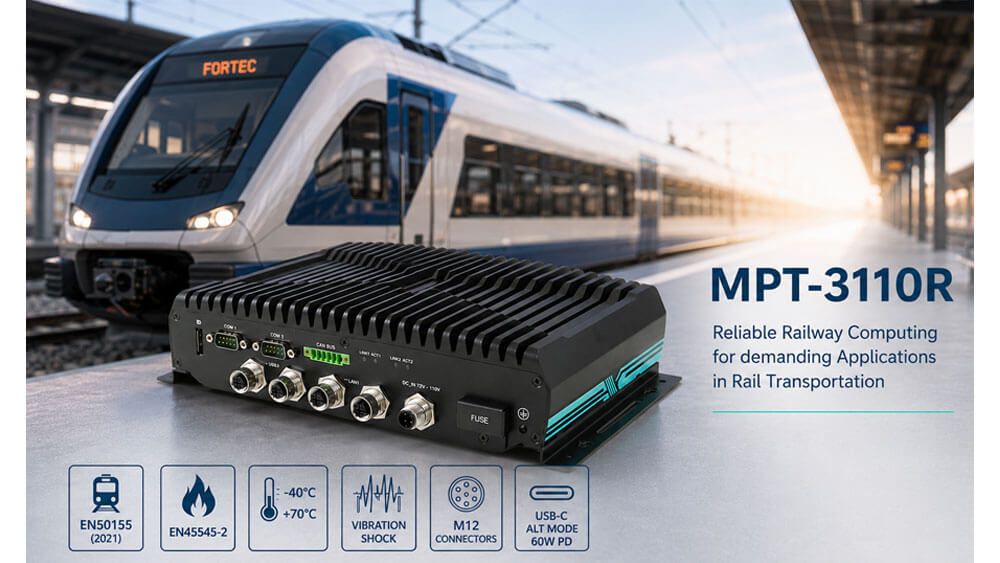
For the computer on the same train, our post on railway-certified computers covers an EN 50155 box PC and a rugged COM Express module.
What else makes up an industrial IoT network?
Gateways and switches. Routers carry data securely to the cloud, while:
- Gateways such as the TRB246 translate data formats, so incompatible devices and networks can communicate. It is a 4G LTE gateway with I/Os, RS232, RS485, Ethernet, and dual SIM, supports protocols such as DNP3, DLMS, and Modbus, and comes in a rugged aluminum housing.
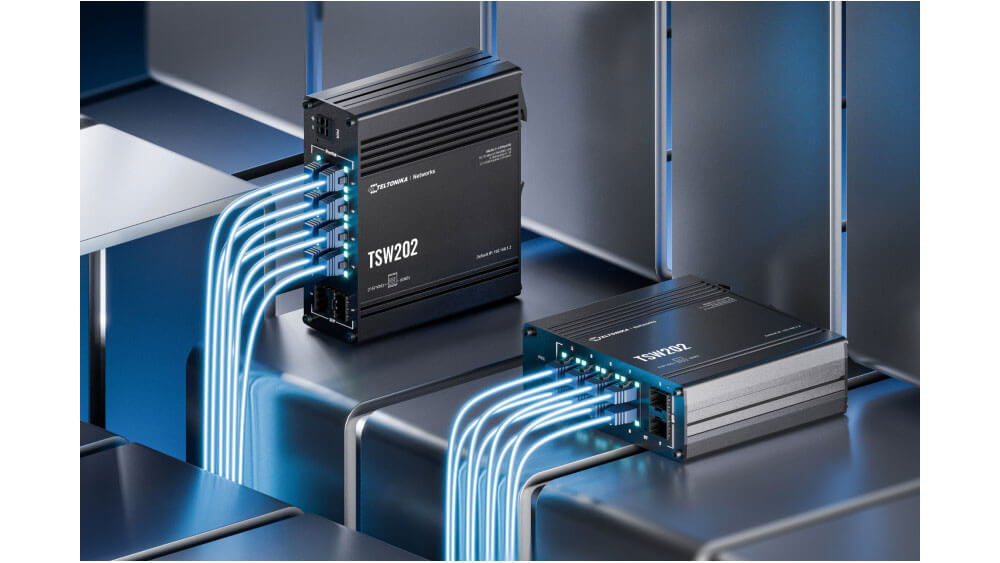
- Switches such as the TSW101 manage data flows and make efficient use of bandwidth. It is an automotive switch with five Gigabit Ethernet ports, four of them PoE+, powered directly from a 12 V or 24 V vehicle battery.
Tell us what has to stay connected and where, and we will take it from there. We recommend the router, gateway, or switch, integrate it with the computer and display it serves, and stay with the project from first samples to series production, backed by our technical services.