Back to Blog
How Do You Design a Display for Harsh Environments?
October 12, 2026
By Jackie Hatfield, Regional Sales Engineer, FORTEC US
Designing a display assembly for a harsh environment starts with the environment it will face. The conditions it has to withstand decide what every part of the assembly has to be: the panel, the optical bonding, the touchscreen, the cover glass, the mechanical enclosure, the seals, and the cables and connectors. Those choices are made at the design stage, before a single unit is built, which is where they are easiest and least expensive to get right.
I work with OEMs across the western US and western Canada, where one product line can face desert sun in Arizona one week and a Montana winter the next. Below is how I approach these designs with engineering teams, and how the conditions in the West shape each part of the assembly.
What makes an environment harsh for a display assembly?
Moisture, dust, temperature swings, shock, vibration, chemicals and direct sunlight, usually several at once. Each one puts pressure on a different part of the assembly: condensation forms in any air gap behind the cover glass, vibration works on connectors and cables, heat builds up inside a sealed enclosure, and sunlight washes out an unbonded screen. Cold matters too. Liquid crystal responds more slowly at low temperatures, so a display that starts the day well below freezing can be sluggish until it warms up.
Which applications need a harsh-environment display assembly?
Any display that works outside a clean, climate-controlled room. What matters most in each:
- Factory automation and machine HMIs (Industrial): oils, dust, washdown and vibration. Front sealing, sealed connectors and a wide operating temperature range come first.
- EV charging stations and outdoor kiosks: direct sun, heat, cold and public handling. High brightness, optical bonding, impact-resistant cover glass and sealing all round.
- Theme park rides and outdoor venues: continuous duty outdoors and in public view, in sun and weather. Sunlight readability, sealing and long-term reliability come first.
- Defense vehicles and portable systems (Defense): shock, vibration, wide temperature ranges and night-vision (NVIS) compatibility, typically specified against MIL-STD-810.
- Field and portable instruments: outdoor use, drops and temperature changes. Bonding for impact strength and sealed ports.
- Medical devices (Medical): repeated cleaning with disinfectants. A sealed front and a cover glass that withstands the cleaning agents.
These are examples, not limits. We design into whatever context a product requires, from a one-off specialist instrument to a display assembly built for a whole fleet. Behind us is the FORTEC Group, with locations in seven countries, coordinated as one network. When a customization or a quantity goes beyond what we do in house, we place it with the Group site best suited to it and deliver it as one project.
How does optical bonding protect a display assembly?
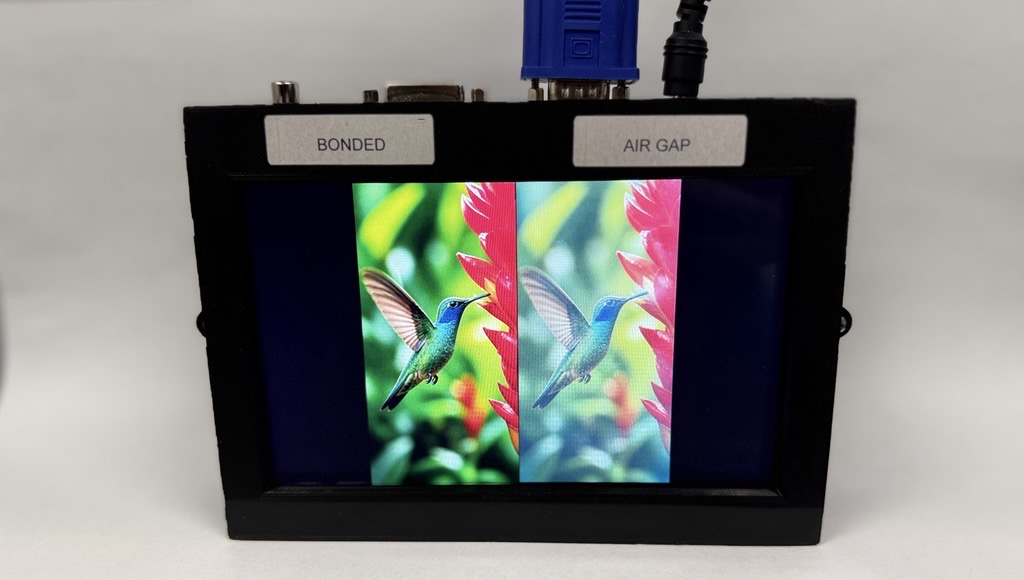
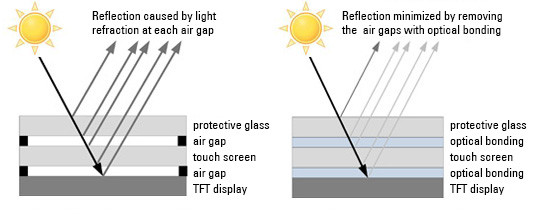
It removes the air gap between the panel and the touchscreen and cover glass, which is where condensation forms, where reflections multiply, and where impact energy travels straight into the LCD. Optical bonding fills that gap with a clear adhesive and joins the panel, touchscreen and cover glass into a single unit. There is no air to fog and nothing to reflect, and the cover glass, which gives the assembly its strength, shares the load of an impact with everything behind it.
In the West, condensation is not only a coastal problem. A hot day followed by a cold night at altitude in Colorado, Utah or New Mexico can fog an unbonded display just as Pacific coast fog can.
The cover glass and the touch technology are chosen for the environment too: the impact the assembly has to survive, whether operators wear gloves, and how it will be cleaned.
How well the gap is filled matters as much as whether it is filled. VacuBond®, our optical bonding process, is done in-house at our Ronkonkoma facility, which includes a clean room. It bonds under vacuum so that air and microbubbles stay out of the adhesive layer. That matters most on larger displays, where conventional bonding is most likely to trap bubbles, and it avoids the mirror effect visible on poorly bonded displays. (How VacuBond compares to traditional optical bonding.)
The difference shows up under thermal cycling. In one VacuBond project, a customer cycled finished outdoor terminals 100 times between -40°C and +80°C. The stress was severe enough to deform and partly detach the internal polarizer inside the 7″ and 15.4″ TFT panels themselves. The VacuBond bond passed without any defects.
What does the mechanical enclosure need to do?
Hold the bonded display without stressing it, seal it, and get its heat out. The enclosure carries the mechanical load of the assembly, so it has to support the panel and cover glass evenly and isolate them from the shock and vibration of whatever it is mounted to. It is also what the seals press against, so its flatness, fastener spacing and gasket design decide whether the IP rating holds.
Heat is the third job, and in Arizona or Nevada sun it can decide the design. A sealed enclosure has no airflow, so heat from the backlight has to leave by conduction through the housing, while the sun on the housing adds heat of its own. The inside can run far hotter than the air around it, and a high-brightness display for sunlight readability adds more. Metal housings conduct that heat out and shield against interference; plastic housings are lighter but hold heat in. The right choice follows from the environment and the brightness the application needs.
What IP rating does a harsh-environment display assembly need?
It depends on what the assembly will face, and the front and the full unit often need different ratings. IP ratings are defined in IEC 60529, where the first digit covers solids and the second covers water. The most common for harsh environments:
- IP65: dust-tight, and protected against water jets from any direction. A common baseline for outdoor and industrial equipment.
- IP66: dust-tight, and protected against powerful water jets.
- IP67: dust-tight, and protected against temporary immersion, up to 1 m for 30 minutes.
- IP69K: protected against high-pressure, high-temperature washdown, common in food processing. This one is defined separately, in ISO 20653.
A panel-mount display assembly sealed at the front relies on the cabinet it sits in for everything behind the bezel. One sealed all round has to protect its own rear, including every point where a cable enters. Temperature cycling makes this harder than it looks: as the enclosure heats and cools, it draws air in through any leak path, and that air brings moisture with it.
Location changes the answer. On the California, Oregon and Washington coast, salt air adds corrosion, so the seals, fasteners and connector hardware have to stand up to it as well as to water. In food processing, including California’s Central Valley, high-pressure washdown is what pushes a specification toward IP69K. I recommend the rating based on how and where the display will be used, so it holds in the field and not only on paper.
Our IP6X monitors are an example of sealing the whole unit rather than just the front: the compact 7″ and 10.1″ PCAP touch monitors with an IP65-rated housing, up to 1,500 cd/m² for sunlight readability, and a waterproof, dustproof cable carrying HDMI and USB.
Why design cables and connectors in from the start?
Because they decide whether the seal and the signal hold, and they are easiest to get right before the enclosure is drawn. Every cable entry is a gap in the seal, and a connector that admits moisture or loosens under vibration rarely fails outright. It fails intermittently, which makes it one of the hardest problems to trace later.
In Idaho, Montana, Wyoming and western Canada, cold adds another reason. Cable jackets stiffen and gaskets harden at low temperatures, so a connector that seals well in the lab can leak or crack after a winter of cold starts. The choices that prevent all of this are part of what we design in:
- Short, internal video links. LVDS and eDP are designed for short runs between a computer and a panel, so mounting the computer directly behind the display removes the longest and most exposed video cable from the design.
- Fewer cables. Our BPCPRO-X51 box PC carries DisplayPort video, touch and power over a single screw-locking USB-C cable, so one locked connection replaces three.
- External connectors sealed to the same level as the enclosure. A sealed housing with an unsealed connector is only as well protected as the connector.
- Locking connectors and strain relief, with every cable routed where vibration cannot wear it against an edge.
- Complete, tested cable assemblies rather than wiring done at installation, so the seal does not depend on who installs the unit.
What do I ask before designing a harsh-environment display assembly?
Most of the engineers I work with know their application better than anyone. What I bring is depth on the display side, and the questions that connect it to their application. Some arrive with a full specification, and we work from it. Others arrive with a problem to solve, and I ask the right questions and turn the answers into a design. Either way, my first conversation with an engineering team usually covers:
- Where will the display be used, and what will it be exposed to: heat, cold, water, dust, chemicals, sunlight?
- Will it be mounted in a panel or cabinet, or does it need to stand on its own?
- How will people use it: touch, gloves, viewing angle, day and night?
- Will it be moved, carried, or mounted on a vehicle or vessel?
- How will it be cleaned or maintained?
- What does it need to connect to, and what power is available where it is installed?
- How many units, and for how many years?
From there, we work through each part of the assembly with the customer’s engineering team and come back with one recommendation for the whole display assembly.
Across the West, we see applications ranging from outdoor equipment exposed to extreme temperatures and direct sunlight to industrial systems that must withstand vibration, dust, and constant use. Customers are looking for more than a display that meets a specification. They want a solution that’s engineered for their application and dependable over years of production.
Jackie Hatfield, Regional Sales Engineer, FORTEC US
Why bring us in at the design stage?
Because every problem in this post is easiest to solve before anything is built. Many of our customers first came to us after a display assembly from elsewhere failed in the field: fogging after a cold night, overheating in a sealed enclosure or in direct sun, touch dropouts on a vibrating machine, or intermittent faults nobody could reproduce. We found where each assembly was failing and redesigned that part so it holds. But every one of those problems could have been designed out from the start, without the returns, site visits and lost goodwill that came first.
FORTEC US is not a distributor passing parts along. We design and manufacture complete display assemblies in Ronkonkoma, New York, from standard products to fully customer-specific solutions. Display, embedded and power expertise sit under one roof at FORTEC, so when a project also needs an embedded computer or a power supply, we design it in with the display assembly, including the interfaces between them.
Designing for the field
A harsh-environment display assembly lasts only as long as its weakest part, and the time to find that part is at the design stage, not in the field.
Planning a display for an industrial, defense or outdoor environment? Tell me where it has to work, and we will take it from there. I will recommend the right display assembly, and our team handles the integration and the sourcing and stays with the project from first samples to series production, so there is one partner to work with instead of several suppliers to coordinate. Get in touch about your project.
I cover Arizona, California, Colorado, Idaho, Montana, Nevada, New Mexico, Oregon, Utah, Washington, Wyoming and western Canada, and my colleagues cover the rest of North America.
Related: The Importance of Optical Bonding in Harsh Environments, Integrating Touchscreens into Harsh Environments and What Makes a Display Industrial Grade?
How to Choose an Edge AI Computer for a Medical Device
September 29, 2026
Embedded PCs vs. Consumer PCs: What’s the Difference?
August 31, 2026

How Hover Touch Technology Can Improve Industrial Interfaces
August 31, 2026
The Real Cost of Choosing the Wrong Display for an Industrial Product
August 28, 2026

What to Look for in a Long-Term Industrial Technology Partner
August 24, 2026
What Is an Embedded System?
August 7, 2026