Back to Blog
Which Optical Bonding Material Is Best: Silicone OCA, Acrylic OCA, or LOCA?
October 15, 2026
By Scott Makboulian, Managing Director, FORTEC US
For a display assembly that has to last in the field, silicone OCA applied by vacuum bonding, also called dry optical bonding, is the most durable of the three main optical bonding materials. It does not yellow, it absorbs shock, it needs no curing time or dam, and a bonded unit can be reworked. It is the material behind VacuBond® optical bonding with silicone OCA, which we carry out in-house in Ronkonkoma, New York, on displays up to 32 inches.
What are the main optical bonding materials?
The three main optical bonding materials today are acrylic OCA, an optically clear adhesive supplied as tape; LOCA, a liquid optically clear adhesive (also called OCR, optically clear resin) that is dispensed and UV-cured; and silicone OCA, a silicone optical bonding gel supplied ready-formed and laminated under vacuum. Older bonds also used urethane and epoxy. All of them are optical bonding adhesives that fill the air gap between the panel and the touchscreen or cover glass. They differ in how they are applied, how thick a layer they form, and how they age.
| Property | Acrylic OCA | LOCA / OCR | Silicone OCA (VacuBond) |
|---|---|---|---|
| Material | Acrylic | Acrylic-silicone | Silicone |
| Form and process | Adhesive tape, autoclave | Liquid, gap filling and UV curing | Ready-formed OCA, vacuum lamination |
| Layer thickness | 0.025 to 0.25 mm | Under 0.4 mm | 0.175 to 1.8 mm (0.5, 1.0, and 1.8 mm standard) |
| Weather resistance, durability, and yellowing | Good | Good | Excellent |
| Impact absorption and stress relaxation | Restricted | Restricted | Premium (viscoelastic) |
| Reworkability | Restricted | Restricted | Outstanding |
How thick is an optical bonding layer?
Silicone OCA is available from 0.175 mm to 1.8 mm thick. The standard thicknesses are 0.5, 1.0, and 1.8 mm, most others are special order, and a custom thickness can be made when the volume justifies it. At up to 1.8 mm, silicone OCA fills gaps several times deeper than the 0.25 mm an acrylic tape reaches, and the gap-filling process that LOCA relies on is complex. How easily a silicone OCA bond can be reworked depends on the components, whether their surfaces were activated, and how accessible the joint is.
Does optical bonding yellow over time?
It depends on the material: urethane bonds do, and silicone OCA does not. Silicone’s chemical bonds are strong enough that UV and visible light do not split them. Urethane behaves differently. Its hard segments are built from isocyanates, and as those oxidize they form quinone-based segments, which are yellow. Aromatic isocyanates are widely used in urethane production to control the reaction rate, so this yellowing is essentially unavoidable. In the material manufacturer’s tests, silicone performed significantly better than both urethane resin and acrylic, and that is the basis of the long-term material stability of a VacuBond bond.
What is dry optical bonding, and how is it different from wet bonding?
Dry optical bonding laminates a ready-formed sheet of silicone OCA in a fully automated vacuum process, so there is no liquid to contain and nothing to cure. That removes several of the steps and constraints of the other methods:
- No dam built around the panel to hold liquid adhesive, and no drying or curing time.
- No stable TFT frame needed. Slim panels without a metal housing, and frameless TFT cells, can be bonded. A small display with a very narrow bezel and fragile mechanics may allow neither tape assembly nor wet bonding.
- Room-temperature assembly, unlike autoclave assembly, which can exceed the maximum specified temperature of the touchscreen.
- No cosmetic defect specification. The process produces no opaque or translucent anomalies, so a detailed optical defect specification becomes unnecessary.
- A reversible bond. We can re-bond a unit for repair, so no expensive material is lost.
The video below shows the VacuBond process.
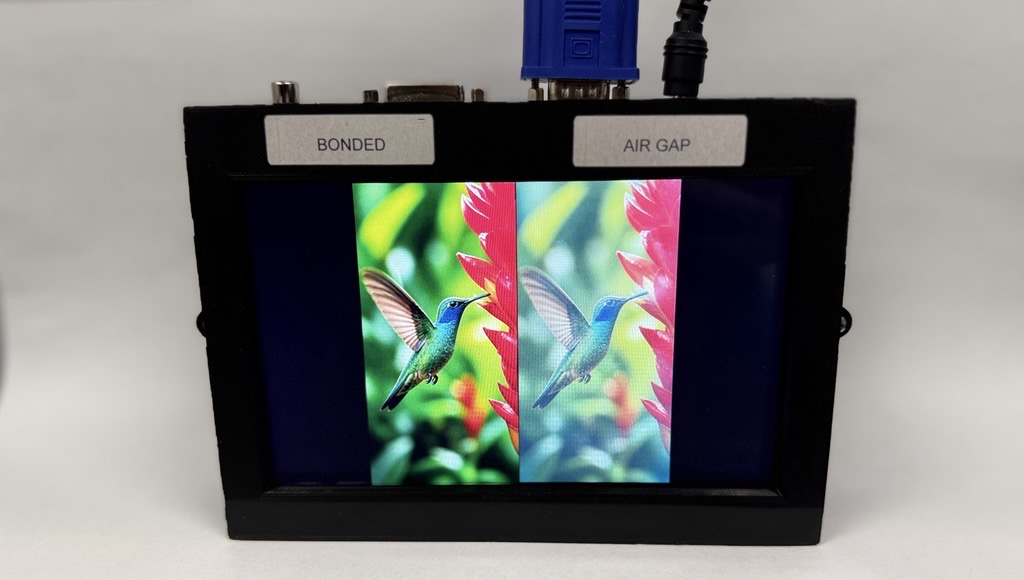
The image is more even too. Mura, the uneven luminance that shows as cloudiness or flashing, measured only 46% of the wet-bonding level. A bond without defects also avoids the mirror effect visible on poorly bonded displays.
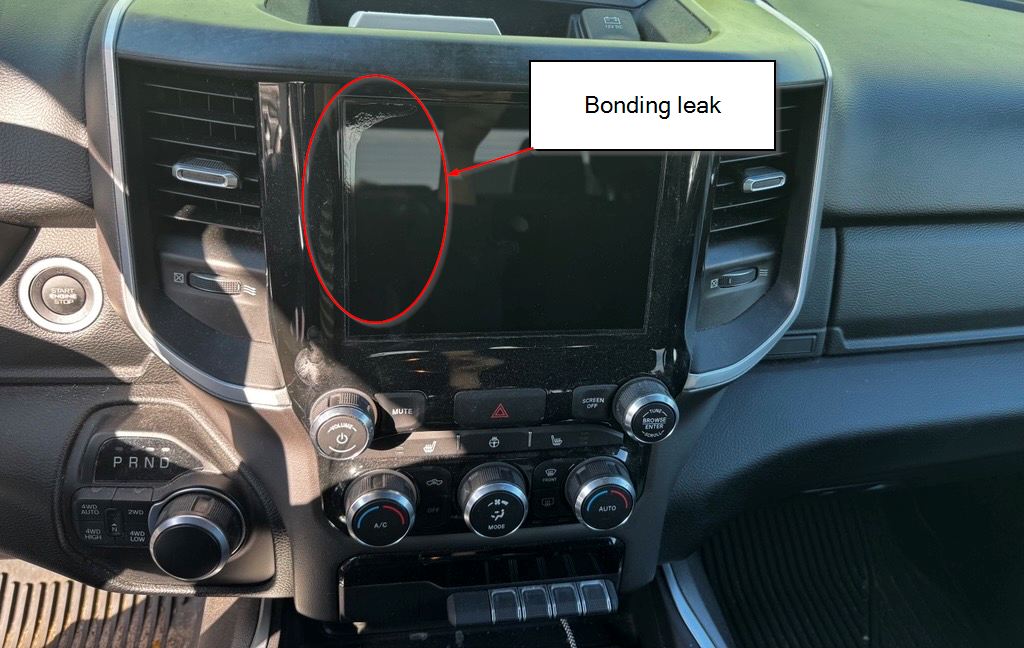
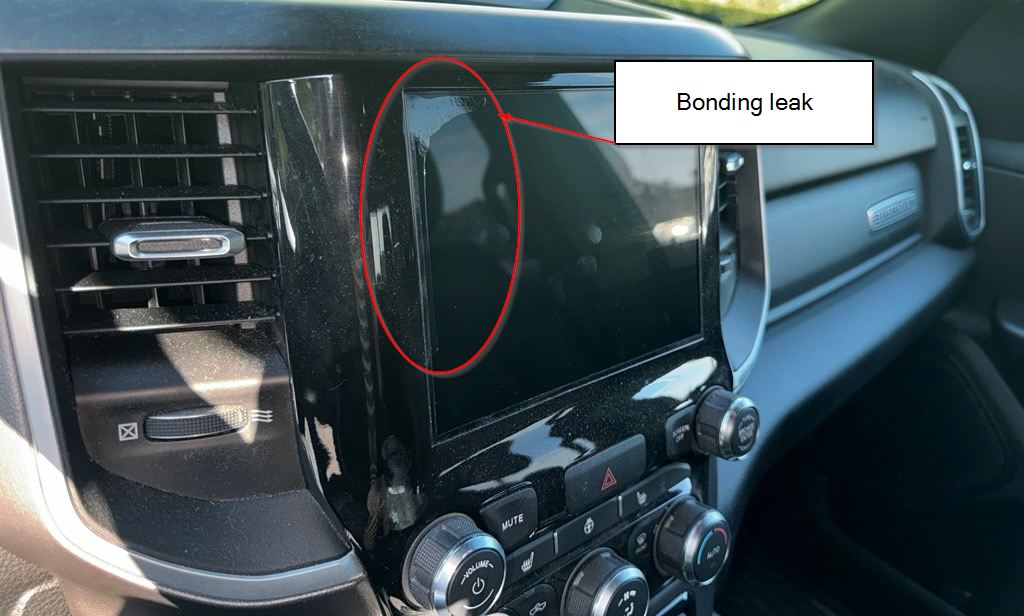
Does optical bonding leak?
Liquid bonding can, and dry optical bonding avoids it. In wet bonding the adhesive goes on as a liquid, and adhesive that escapes the bond area can seep into the panel edges or the backlight. The photos below are of the display in my own truck. Dry optical bonding uses ready-formed silicone OCA, so there is no liquid to seep. Leakage is a real problem with liquid bonding, and preventing it is one of VacuBond’s strengths.
What display sizes can be optically bonded with VacuBond?
Displays up to 32 inches, using the same silicone OCA process at every size. At the small end, VacuBond bonds sensitive TFTs, e-paper, and OLED displays reliably and cost-efficiently, down to 1.8 inches, the smallest we have bonded so far. There is no real lower limit, and we can go smaller when a project needs it. At the large end, one example is a 32-inch e-paper display bonded to protective glass. No design is too custom. Complex assemblies are the work we look for. Options include bonding:
- directly into the customer’s own front panel,
- airtight, with the open areas of the TFT back cover filled,
- to protective glass of any thickness, for increased ruggedness,
- with free air exclusion for explosion-protected applications: we measure every free air space inside the display’s mechanical structure, fill it with silicone layers of 0.5 to 1.8 mm, reassemble the display, and then bond the touchscreen or protective glass.
What are the benefits of optical bonding over an air gap?
Readability, robustness, and heat transfer, all from closing the air gap between the panel and the touchscreen or cover glass:
- Better contrast and sunlight readability at the same power consumption, because internal reflections are eliminated.
- No condensation, fogging, or contamination inside the assembly.
- Less danger of splintering if the glass breaks.
- Better shock absorption and a more robust construction.
- Heat transfer through the front glass improved by up to a factor of eight.
VacuBond bonds touchscreens of all common technologies: projected capacitive (PCAP), by far the most common, in glass/glass, glass/film, and film/film constructions, as well as resistive and AMR. Our TG-DD1850-A02, an 18.5-inch PCAP touch-glass sensor with USB and I²C interfaces, is one of many touchscreens we combine with a protective glass in the customer’s own design.
Can VacuBond bond displays with EMI filters?
Yes. VacuBond is compatible with EMI filters, which bond into the display stack like the other layers. EMI filters are common in Medical and Defense displays, and EMI shields and ITO EMI coatings can be designed into the same assembly.
What testing has VacuBond passed?
FORTEC VacuBond units have passed these tests in customers’ own test laboratories:
- Damp heat to the railway standard EN 50155: cycles at +55°C and 95 to 100% relative humidity, dropping to +25°C at 90 to 95%, with a function test after 24 hours.
- Shock and vibration to EN 61373, Category 1, Class B, against the requirements of IEC 60571 for electronic equipment on rolling stock.
- Low and high temperature to IEC 60068-2: 504 hours at -40°C and 504 hours at +80°C.
- Temperature cycling to IEC 60068-2-14: 100 cycles between -40°C and +80°C, 30 minutes at each extreme, changing at 10 K per minute.
- Steady damp heat to IEC 60068-2-78: 504 hours at +60°C and 95% relative humidity.
With protective glass bonded by VacuBond, assemblies have also passed ball drop tests, IEC 60721-3-7, and MIL-STD-810F. In one VacuBond project, a customer cycled outdoor terminals with 7-inch and 15.4-inch displays 100 times between -40°C and +80°C. The internal polarizers of the TFT panels deformed and partly detached, and the VacuBond bond passed without defects.
The video below shows a ball drop test.
Separately, silicone OCA itself has been tested by its manufacturer and independent laboratories, including to MIL-STD-810G and MIL-STD-461, the DIN 75220 sun simulation for automotive components, the DO-160E avionics fire test, and FMVSS 302, where it was self-extinguishing. These results show what the material withstands. Qualifying the finished unit for its intended use stays with the customer’s engineering team, and we support that with samples.
Why choose the bonding at the design stage?
Because the bonding material and process shape the mechanical design: whether the panel needs a frame, how deep a gap can be filled, whether the cover glass can be bonded straight into the housing, and whether a unit can be reworked later. Customers often come to us after displays have failed in the field with fogging, overheating, touch dropouts, or intermittent faults. We solve them, but each could have been designed out with us involved from the start.
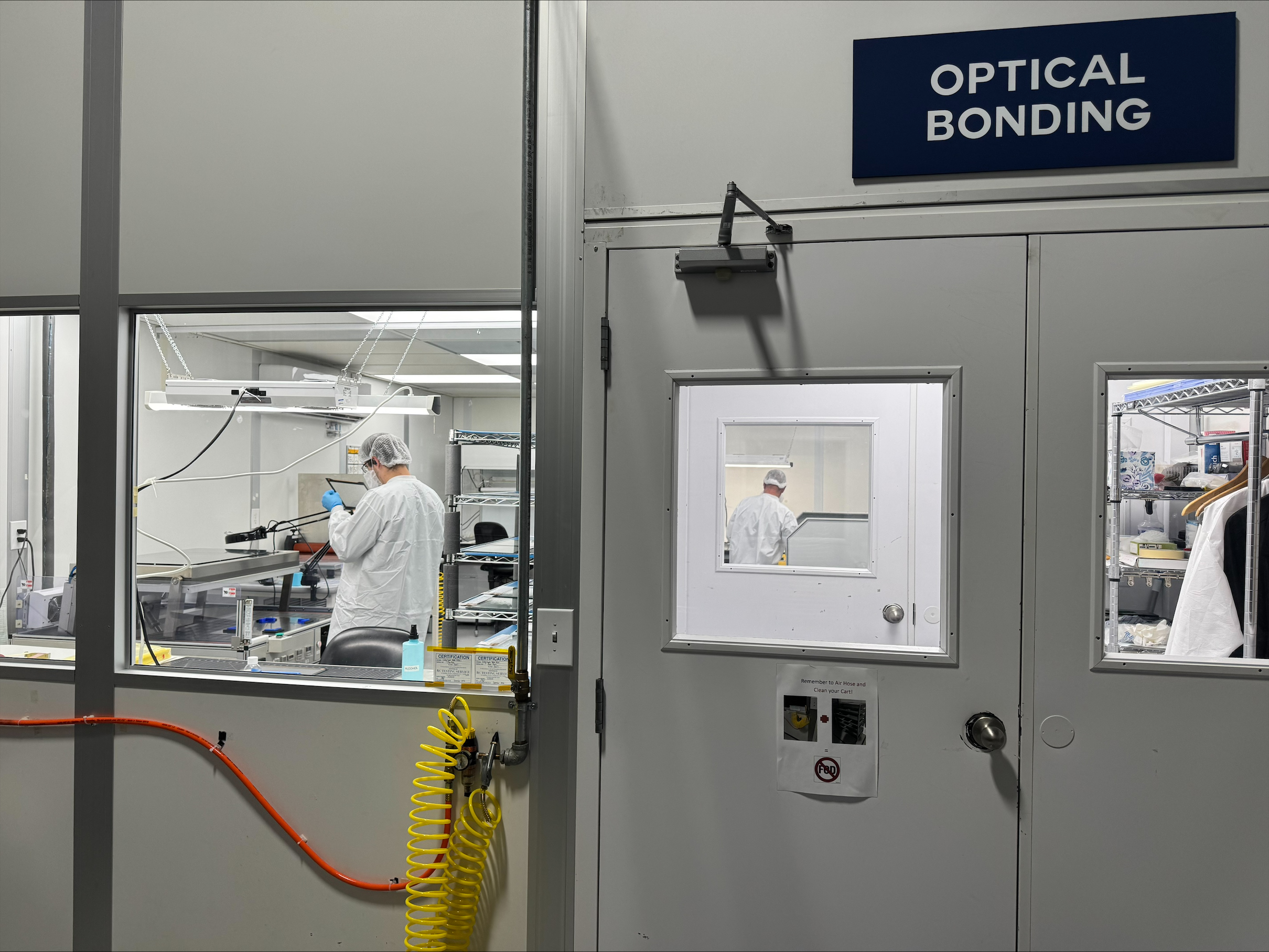
We are not a distributor. We design and manufacture display assemblies in Ronkonkoma, and VacuBond optical bonding runs in our clean room there. Identical machines and processes run at FORTEC Group sites in Germering, Germany, and the Czech Republic, so production of a bonded assembly does not depend on one location. Display, embedded, and power expertise sit under one roof at FORTEC, so when the assembly also needs a computer or a power supply, one engineering team is accountable for all of it.
Optical bonding pays off wherever a display faces sunlight, moisture, shock, or vibration, from Industrial HMIs and Medical devices to Defense systems. These are examples, not limits. We design into whatever context the product requires, with deep customization on one design and the Group’s capacity to scale it into volume.
Planning a bonded display assembly?
Tell us where it has to work, and we will take it from there. We recommend the right panel, touchscreen, cover glass, and bonding for the application, handle the integration and the sourcing, and stay with the project from first samples to series production through our technical services. We also manage obsolescence for the life of the product: when a part in an assembly receives an end-of-life notice, we tell customers early and plan the next step with them, whether that is a last-time buy to cover the remaining builds or qualifying a replacement before supply runs out. Get in touch about your project.
Related: How Do You Design a Display for Harsh Environments? and How Does VacuBond® Technology Compare to Traditional Optical Bonding?
How Do You Design a Display for Harsh Environments?
October 12, 2026
How to Choose an Edge AI Computer for a Medical Device
September 29, 2026

Embedded PCs vs. Consumer PCs: What’s the Difference?
August 31, 2026

How Hover Touch Technology Can Improve Industrial Interfaces
August 31, 2026

The Real Cost of Choosing the Wrong Display for an Industrial Product
August 28, 2026

What to Look for in a Long-Term Industrial Technology Partner
August 24, 2026