Back to News Feed
Which Advantech MIO Pico-ITX or 3.5-Inch SBC Fits a Compact Industrial Design?
May 12, 2023
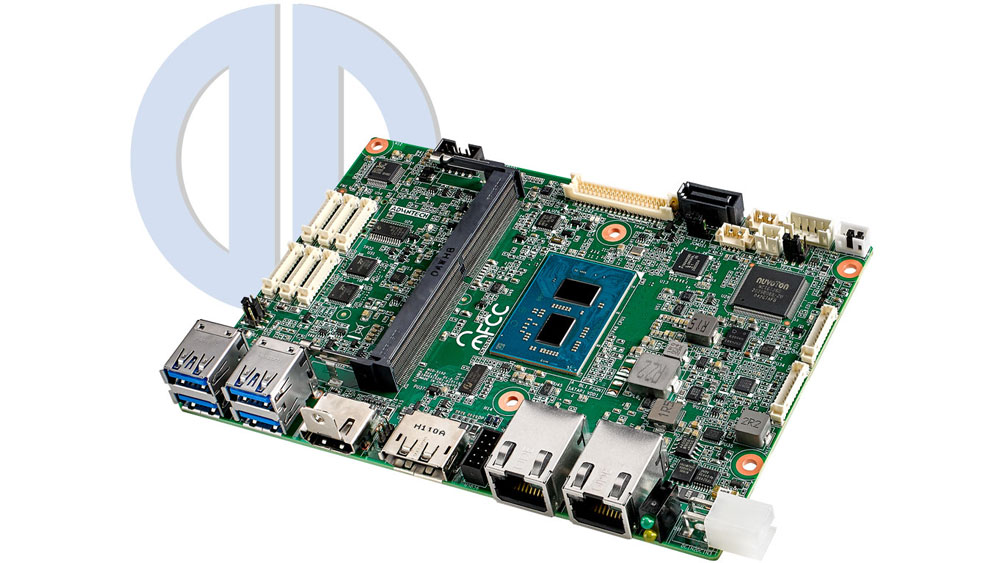
It depends on the space available and the processing the design needs. Advantech’s MIO boards come in two compact formats: the 2.5-inch Pico-ITX MIO-2361 and MIO-2375, which measure only 100 × 72 mm, and the 3.5-inch MIO-5152, which drives up to three 4K displays. All three are long-term available and rated -40 to +85°C. We supply them from Ronkonkoma, New York, alone or with a matching display, touch and accessories.
| Board | Format | Processor | Displays |
|---|---|---|---|
| MIO-2361 | 2.5-inch Pico-ITX | Intel® Atom™ E39xx or Pentium® N4200 (Apollo Lake) | 2 independent: 48-bit LVDS and HDMI |
| MIO-2375 | 2.5-inch Pico-ITX | 11th Gen Intel® Core™ i3, i5 or i7 | LVDS, or DisplayPort up to 8K |
| MIO-5152 | 3.5-inch SBC | Intel® Atom™ x6425E, Celeron® N6210 or J6412 (Elkhart Lake) | Up to 3 independent: LVDS, DP 1.4, HDMI 2.0, up to 4K at 60 Hz |
Which board suits the harshest conditions in the least space?
The MIO-2361. It is fanless, so it has no potentially susceptible moving parts, and it withstands vibration, harsh environments and -40 to +85°C, which suits extreme uses such as process monitoring in steel production. A codec for HEVC/H.265 gives it strong 4K graphics. It comes with 4 GB LPDDR4-2400 and 32 GB eMMC onboard, expands through M.2 E-Key and mSATA or Mini-PCIe, and adds dual GbE, USB 3.0, two RS-232/422/485 ports, a 12 or 24 V input, iManager 3.0 and embedded software APIs, with flexible multi-I/O for integrators.
Which board puts Core i performance into Pico-ITX?
The MIO-2375, with an 11th Gen Intel® Core™ i3-1115G4E, i5-1145G7E, i7-1185GRE or i7-1185G7E. Its LPDDR4x memory is soldered on at up to 4,267 MHz, 8 or 16 GB as standard and up to 32 GB on request. It adds two GbE, SATA III with SATA power, I²C, two COM ports, 4-bit GPIO, HD audio, a watchdog timer, two USB 3.2 and two USB 2.0 ports, M.2 Key E and Key B slots, and TPM 2.0 for Windows 11, with a 12 V DC input.
When does the 3.5-inch MIO-5152 make more sense?
When the design needs more displays and I/O at low power. The MIO-5152’s quad- or dual-core processors run at a CPU TDP of 6 to 12 W, which allows cost-effective, fanless designs for medical, transportation and measurement applications. It takes up to 32 GB DDR4-3200 in one SO-DIMM socket and supports Windows 10 LTSC, Ubuntu 20.04 LTS, embedded software APIs and WISE-DeviceOn. It adds I²C and eSPI, two GbE, M.2 2242 Key M and SATA III for storage, an M.2 2230 Key E socket with Nano-SIM, four RS232 and two RS232/422/485 ports, six USB ports (four at USB 3.2 Gen 2, 10 Gbps), TPM 2.0 and a watchdog timer.
Can an x86 board boot as fast as an ARM platform?
Yes, on selected x86 platforms with Advantech’s Slim Bootloader. It replaces the conventional BIOS, and it can boot an x86 system even faster than is typically expected from ARM platforms. Advantech developed it as an open source project based on Intel’s boot firmware, with the emphasis on speed, security and a small footprint, so it significantly shortens boot time. Ask us whether it is available for the board you are considering.
How do we deliver a MIO board?
As a board, or with a matching display, cables, touch and accessories such as RAM, an SSD and a pre-installed operating system. Our full ranges are on the 2.5-inch Pico-ITX and 3.5-inch compact SBCs pages; for iBASE alternatives, see which 3.5-inch industrial SBC fits your embedded design. Tell us what the system has to run and where, and we will take it from there, drawing on the FORTEC Group where needed. When a board receives an EOL notice, we tell you early and plan with you: a last-time buy to cover remaining builds, or qualifying a replacement before supply runs out.