Back to News Feed
How Can a Display Blend Into a Product or a Space?
April 9, 2026
A display can blend into a design in two ways. It can let the product behind it show through, as a transparent display does, or it can look like something else entirely until it is switched on, as hidden and mirror displays do. We supply both kinds, along with free-standing display totems, and customize them for retail, showroom, trade fair, smart home, and hospitality projects.
How does a transparent OLED display work in signage?
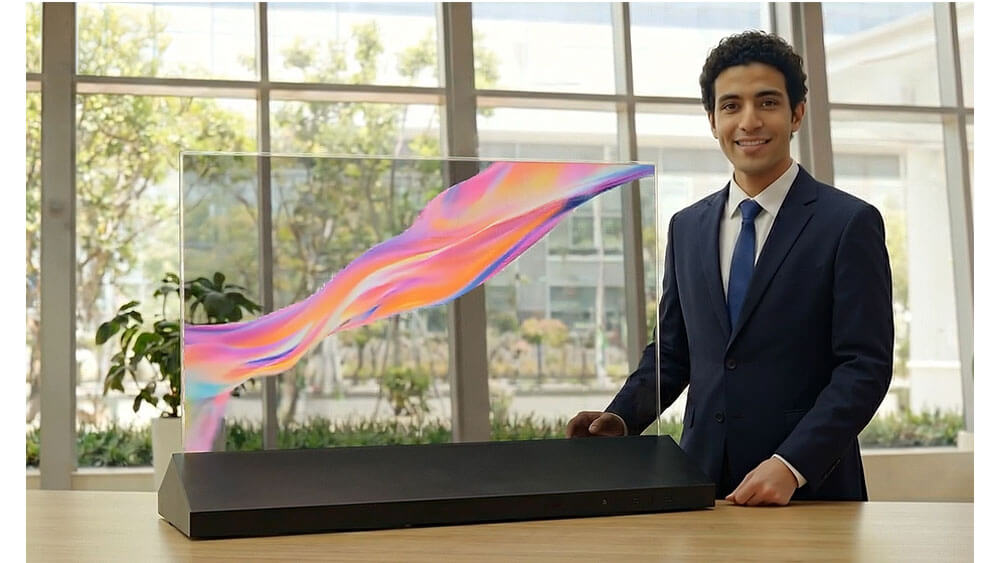
It overlays digital content on real objects. Our transparent 32-inch OLED display is a FORTEC reference design for retail environments, showrooms, and trade fairs: products behind the screen stay visible while the display adds information, animations, or branding in front of them.
- A frameless design that keeps attention on the content and the objects behind it.
- Glass protection on both sides, for stability and easy cleaning.
- A sturdy metal base that houses the TFT controller and keeps the unit stable.
- An external OSD keypad for menu control.
Because it is a reference design, we tailor it to the project, from display size and control to integration into existing systems. For see-through LCDs, our transparent TFT displays work without a backlight, using ambient light, so they draw very little power. More application ideas are in innovative applications of transparent displays.
What is a hidden display?
A hidden display is a TFT display behind a glass surface with a decorative finish, such as wood. Switched off, it looks like an elegant glass-covered surface; switched on, the content appears clearly and vividly on the finish. It suits smart home applications and other high-end environments, where it blends in discreetly without giving up any function.
Our standard model, the FI-HIDDEN-15.6-WD, is a 15.6-inch Full HD display with a wood finish, 350 cd/m², an 80° viewing angle in every direction, 10-point multi-touch, an eDP interface, and an integrated LED backlight driver. A 10.1-inch version is also standard, and we supply either as a plug-and-play kit with a TFT controller and all the accessories. For a different size, a carbon, metal, or stone look, higher brightness, or an extended temperature range, we customize the display to the project; minimum order quantities apply. Our newsletter on hidden displays for sophisticated spaces has more detail.
What is a smart mirror display?
A mirror with a display built in, which becomes visible when it is switched on. The M2G is an 80 × 60 cm mirror with surrounding LED lighting and a 10.1-inch display at 800 × 1280 pixels and 300 cd/m². The content rotates automatically between portrait and landscape. It runs Android 11, connects to smart home and IoT systems over Wi-Fi and Bluetooth, has a 2-finger touchscreen and integrated speakers, and carries an anti-fog coating for humid rooms such as bathrooms. The aluminum alloy housing mounts with a VESA bracket. Options include light color and color temperature, more touch points, and voice control, which makes it a fit for bathrooms, smart home environments, and the hospitality industry.
Where does a display totem fit?
In showrooms and other venues that need a free-standing, interactive screen for products or events. The BOE totems we introduced came in a super-slim white or black design, in sizes from 32 to 85 inches, with 10-point IR touch, 350 cd/m², a 178° viewing angle, Android 9.0, and a minimum service life of 50,000 hours in 12/7 operation. The 55-inch FI55E-RLA is a current example, and the full range is on our display totems page.
These are examples, not limits. We design displays into whatever context the product requires, and a one-off concept can scale into volume through the FORTEC Group. Tell us what the display has to look like when it is off, and where it has to work when it is on, and we will take it from there: we recommend the display, controller, and power together, handle the integration and the sourcing, and stay with the project from first samples to series production.