Back to News Feed
Where Do Bar-Type Displays Fit in OEM and Signage Designs?
November 22, 2017
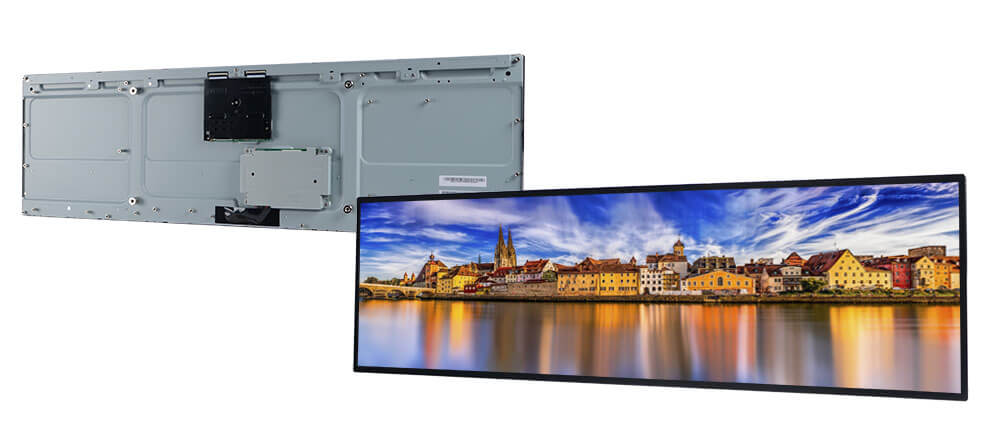
A bar-type display, also called a stretched, ultra-wide, or panorama display, is a TFT panel that is very wide at a low height. It fits wherever there is not enough space for a standard-format display: a narrow strip on a machine, the edge of a shelf, or a sign above head height. We supply bar-type displays from 6.2 to 37 inches as single components, as plug-and-play kits with a controller, and as complete monitors.
Where do bar-type displays fit?
Small and large diagonals solve different problems:
- Small diagonals, such as 8 inches: advertising, information, and status displays in vending machines, coffee machines, laboratory equipment, mechanical engineering, and appliances. An 8-inch bar runs in landscape where height is limited and in portrait where width is.
- Mid sizes, such as 19.2 and 23.1 inches: kiosk and information applications, overhead displays in public transport, and electronic shelf labels for price and product information, tickers, or advertising.
- Large diagonals up to 37 inches: overhead information and advertising displays in public areas, elevators, and fast food restaurants, along with wayfinding systems, menu boards, and slim information displays.
These are examples, not limits. We design bar-type displays into whatever context the product requires.
What should you specify for a bar-type display?
Start with the viewing angle. Bar-type displays are often mounted overhead or along a passageway, so people read them from below, from the side, or while walking past. Wide-angle technologies such as IPS, A-MVA, and Super MVA keep the content readable from those positions, and the panels in our range reach 170° to 178°.
Then brightness and temperature. For screens in high ambient light or direct sunlight, bar-type panels go up to 2,500 cd/m². At that level heat matters too: the 37-inch Innolux S370AJ1-LE1 uses a high-TNI liquid crystal, rated from -40 to +110 °C, that prevents LCD blackout, the display turning black at high temperatures. Operating temperatures for these panels run from -20 to +60 °C and -20 to +70 °C, which also suits warehouses and harsh industrial environments.
Which bar-type displays are current?
- S370AJ1-LE1: Innolux 37-inch, 1920 × 540 pixels, 2,500 cd/m², 5,000:1 contrast, 178° viewing angle, -20 to +60 °C, designed for 24/7 operation, landscape or portrait, LVDS interface.
- GKTS80MNFG1E1: Solomon Goldentek 8-inch, 1600 × 480 pixels, 500 cd/m², IPS with 170° viewing angles, -20 to +70 °C, LED backlight driver integrated in the panel.
- Xtra-Line 37 PME 700 Bartype: a complete 37-inch, 1920 × 540 monitor at 700 cd/m², for portrait or landscape, with an integrated PrismaMEDIA-Eco controller and VGA, HDMI, and DisplayPort inputs.
The full current range is on our bar-type displays page. Several panels from earlier announcements are discontinued: AUO’s 37-inch P370IVN01.0 and P370IVN04.0, AUO’s 28.6-inch G286HAN01.0, Innolux’s 23.1-inch S231AJ1-LE1, Mitsubishi’s 19.2-inch AA192AA01 and its portrait version AA192AA51, and SGD’s 8-inch GWTS80MNFG1E0. If a product of yours uses one of them, our obsolescence management plans a last-time buy or a replacement with you.
How do you drive a bar-type display?
With a controller configured for the panel’s unusual format. We set up our Prisma TFT controller boards with firmware specific to each display, so the OSD menu appears completely within the display area. The S370AJ1-LE1, for example, comes as a ready-to-connect kit with our PrismaMediaECO-II controller and all the necessary accessories. Our Raspberry Pi-based Artista-IoT controllers have also been paired with bar-type panels as plug-and-play kits that can be adapted to a project.
For how bar-type formats compare with square, round, and curved displays, see special format displays: when standard screens aren’t enough.
How do we take a bar-type design from idea to production?
Tell us where the display has to work, and we will take it from there. We recommend the panel, controller, and power together, deliver it as a component, a kit, or a finished monitor, and source through the FORTEC Group. From Ronkonkoma, New York, we stay with the project from first samples to series production, backed by our technical services.