Back to News Feed
How Bright Does a Sunlight-Readable Display Need to Be?
November 25, 2019
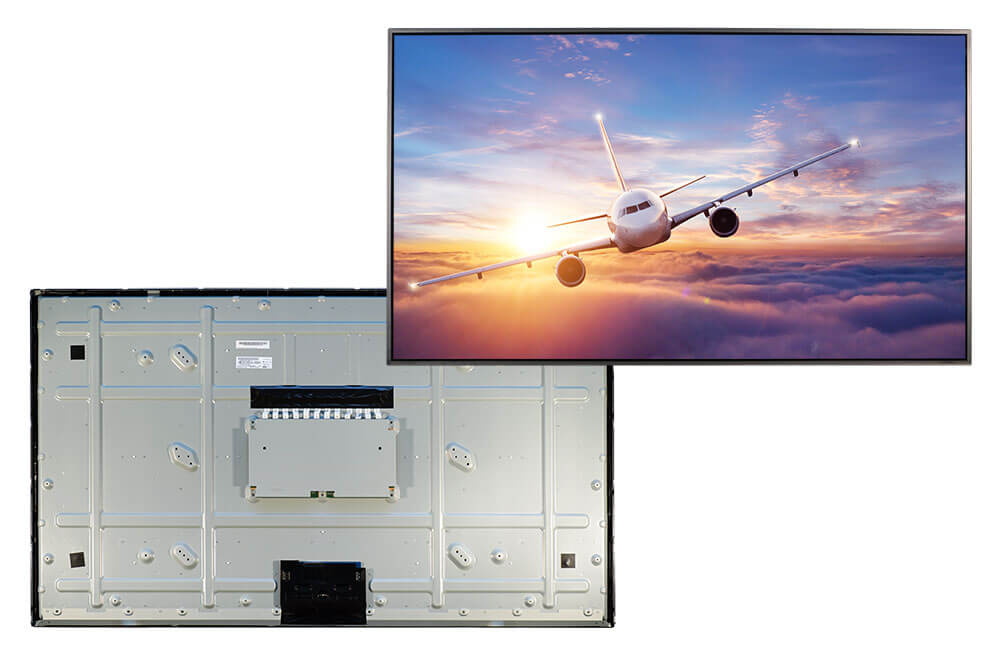
The sunlight-readable TFT displays we supply run at 2,500 to 3,500 cd/m². For scale, AUO’s 31.5-inch P320HVN02.0 for indoor use ran at 450 cd/m², and its twin for bright ambient light, the P320HVN02.1, ran at 1,000 cd/m². Brightness alone is not enough, though. A sunlit display also needs a liquid crystal that does not turn black in the heat, a polarizer that keeps it readable, and brightness control so it does not blind people when the sun goes in. We source high-brightness displays from AUO and BOE, integrate them, and engineer the backlight ourselves when no catalog panel is bright enough.
Why do displays turn black in direct sunlight?
Because sunlight heats the panel past the point where an ordinary liquid crystal stops working, and the image blackens. High-brightness displays prevent this with a high Tni liquid crystal, rated to 110°C, so the content stays visible in strong sun. The AUO P320HVN07.1 and P320HVN07.2 use an advanced liquid crystal specified from -40 to 110°C.
Can viewers wearing polarized sunglasses read the display?
Yes, if the display’s polarizer is chosen for it and the display is mounted in the orientation it was designed for. AUO’s 31.5-inch 2,500 cd/m² display is a good example: the P320HVN07.1 reads correctly with polarized sunglasses in landscape, and the otherwise identical P320HVN07.2 in portrait. So decide the mounting orientation before choosing the panel.
Why does a bright display need a brightness sensor?
So it is only as bright as the conditions require. Outdoor light changes with the weather and the time of day, and a 3,500 cd/m² screen at full power on a cloudy day or at night blinds the viewer and wastes power. Our IF440 light sensor measures ambient light the way the human eye does, and our Prisma and Artista TFT controllers use its data to dim the display automatically, which keeps content readable, saves electricity, and extends backlight life.
Which high-brightness displays can we supply?
- 31.5 inch, AUO P320HVN07.1 (landscape) and P320HVN07.2 (portrait): Full HD, 2,500 cd/m², 4000:1 contrast, A-MVA wide viewing at 89° from all directions, and an extended temperature range of -20 to +60°C. Kit with our PrismaMediaECO-II controller.
- 46 inch, AUO P460HVN05.0: Full HD, 2,500 cd/m², high Tni liquid crystal, suitable for 24/7 operation, LVDS interface. Kit with a Prisma controller, or with our BoxPC Pro NPA-1904 for a complete system.
- 55 inch, AUO P550HVN06.8: 2,500 cd/m², high Tni liquid crystal, and a polarizer that improves sunlight readability. The successor to the P550HVN06.4.
- 55 and 75 inch, BOE DV550QUM-R11 and DV750QUM-R11: UHD at 3,500 cd/m² with a V-by-One interface, long-term available. Kit with our Prisma-4K controller.
- 55 inch monitor, AUO PH55FGN02.0: a complete outdoor-capable monitor at 3,500 cd/m² with automatic brightness adjustment, IP56 and IK10 ratings, 5 mm protective glass, and automatic temperature control within -30 to +50°C. Full HD over HDMI 2.0 or DisplayPort 1.4, 24/7, portrait or landscape.
Earlier high-brightness displays are discontinued: Samsung’s 46, 55, and 75-inch 2,500 cd/m² panels, AUO’s P550HVN06.0 and P550HVN06.4, the 4,500 cd/m² P550HVN12.0, and the 1,000 cd/m² P320HVN02.1. For indoor use, the 31.5-inch P320HVN02.3 replaces the P320HVN02.0.
What if no catalog display is bright enough?
Then we design the backlight. When the display manufacturers do not offer what a project needs, our engineers build the backlight to the customer’s specification: brightness beyond the manufacturer’s offering, long lifetime, typically 100,000 hours, dual-mode night vision (NVIS) solutions, and a configurable dimming range below 1 nit with our SmartLED drivers. Backlight enhancement pairs well with VacuBond® optical bonding for high contrast in bright light. Our guide on how to design a display for harsh environments covers the rest of the assembly.
Tell us where the display will stand and how much sun it will see, and we will take it from there: we recommend the panel, the polarizer and orientation, and the brightness control, integrate the controller, and stay with the project from first samples to series production. When a panel receives an end-of-life notice, we tell our customers early and plan with them: a last-time buy or a qualified replacement before supply runs out. Contact FORTEC US to start.