
Back to Blog

What Should Exhibit Builders Specify in a Museum Touch Screen Display?
October 8, 2019
By Paul Hooper, President, FORTEC US
A museum touch screen display is handled all day by visitors, usually with nobody standing beside it, and the interactive exhibit around it is expected to run for years. Whether it holds up depends on the display assembly behind the glass: the cover glass and how it is bonded, the touchscreen, the brightness, and a supply plan that lasts as long as the installation. All of them shape the enclosure, so they are best settled while the exhibit is still a drawing.
How do you make a public touch screen vandal resistant?
Start with the cover glass, and bond it to the panel. Optical bonding adds impact resistance to the cover glass, so a thinner glass can be used where thickness or weight is critical. If the glass does break, the adhesive holds the larger pieces in place, and for full shatter protection, a safety film can be added on top, which is worth specifying on any screen the public can reach.
In one customer project, a display with VacuBond® optically bonded protective glass took impacts severe enough to bend the display frame. The bond delaminated, but the 3 mm chemically hardened glass did not chip.
The glass is one part of it. We build sealed, vandal-conscious touch displays for unattended equipment, with IP-rated front bezels, so the enclosure around the screen is designed for public use as well as the screen itself.
Why optically bond the display in an interactive exhibit?
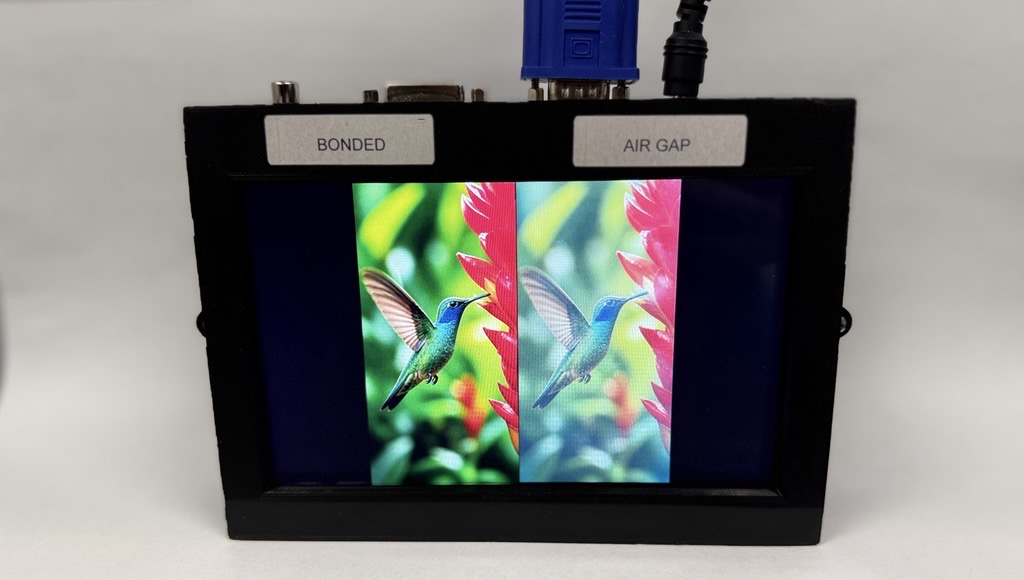
Because bonding fills the air gap between the panel and the cover glass or touchscreen, which eliminates the internal reflections that wash out the image and leaves no space for dust or condensation to collect behind the glass. It also improves heat transfer through the front glass by up to a factor of eight, which helps in a closed exhibit enclosure.
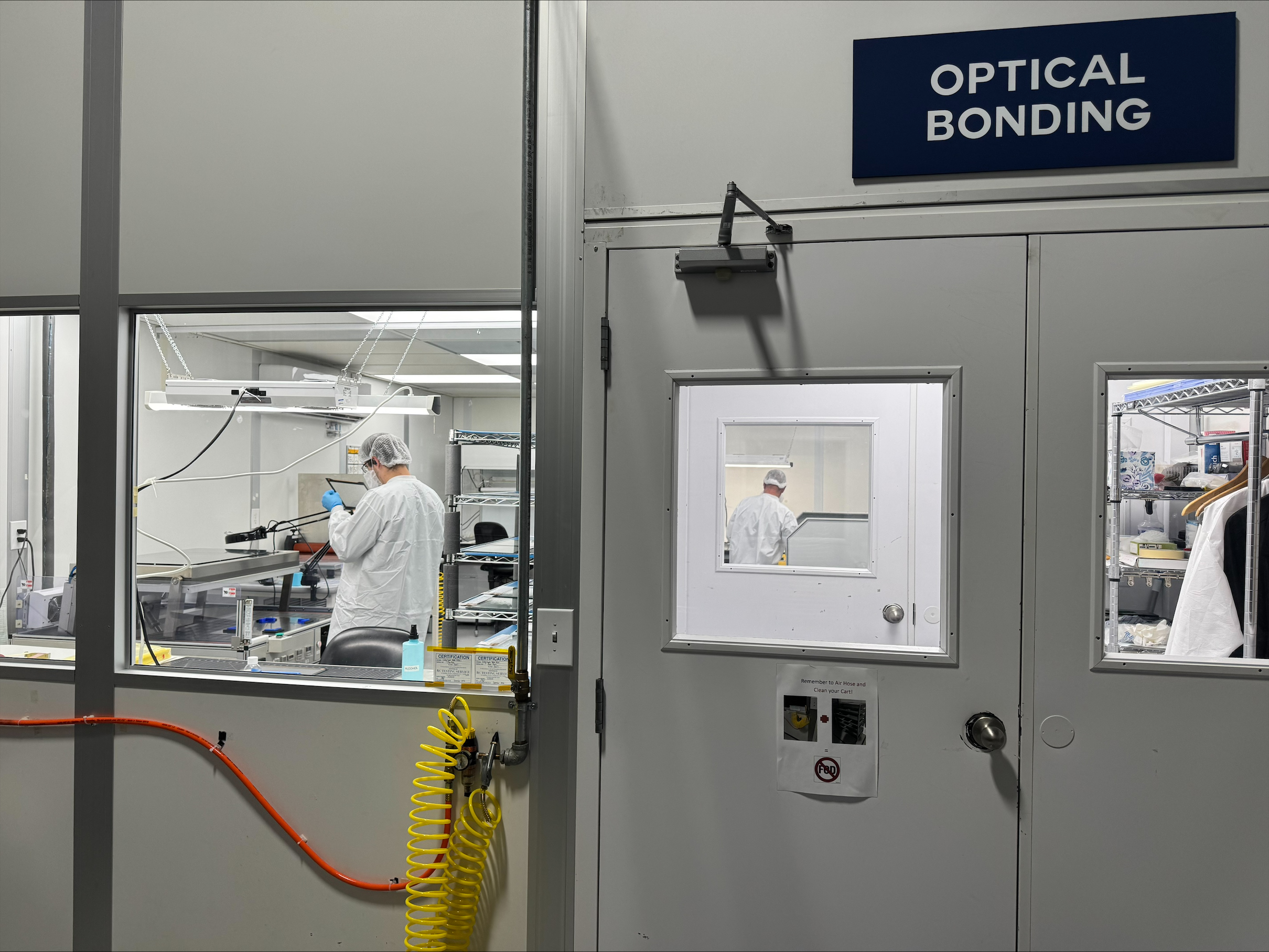
We carry out VacuBond optical bonding in-house in Ronkonkoma, New York, on displays up to 32 inches, with any touchscreen or cover glass. It is a dry process: a ready-formed sheet of silicone OCA is laminated under vacuum, so there is no liquid adhesive to leak, and a bonded unit can be reworked, which suits an installation that is meant to be serviced rather than replaced. Our posts on what VacuBond® technology is, the top five benefits of optical bonding, and optical bonding in interactive kiosk design go further.
Which touch technology suits an interactive exhibit?
Projected capacitive (PCAP) touch, by far the most common touch technology. It senses through a protective cover glass and supports multi-touch, so the glass can be chosen for the exhibit while the sensor sits behind it.
Glass thickness and touch performance are decided together. Our TG-DD1850-A02, an 18.5-inch PCAP touch-glass sensor and one of many we combine with a protective glass in the customer’s own design, supports up to 10 touch points and cover glass up to 6 mm thick, and the number of touch points depends on the thickness of the glass. So the glass chosen for impact and the multi-touch the exhibit’s content needs belong in the same conversation.
For OEM designs, our PCAP touchscreens use a touch foil instead of a separate touch glass, removing a glass layer for a thinner build and better optics. Custom glass shapes and printed logos are available, so the front surface can follow the exhibit’s design rather than a standard rectangle. Our post on how touch screens really work compares PCAP with the alternatives.
How bright should a museum touch screen display be?
It depends on the light where it stands, and bonding lowers the figure needed. In our own sunlight testing, a 600-nit bonded display showed higher contrast under direct sunlight than a 1,000-nit display with an air gap.
Where an exhibit needs more, our backlight enhancement raises brightness beyond the panel manufacturer’s offering, with a long lifetime, typically 100,000 hours. A brightness sensor working with our TFT controllers matches the display to the ambient light, and our SmartLED drivers give a configurable dimming range below 1 nit, so one assembly can suit a bright entrance hall and a darkened gallery.
How long will the display assembly stay available?
For the life of the installation, if supply is planned from the start. Electronic components like TFT displays and controllers follow short product cycles, while an interactive exhibit runs every day, in public view, for years.
We offer extended product lifecycles with controlled change notification, and we monitor every product we offer for manufacturers’ product change notifications (PCN) and end-of-life (EOL) notices. When a part receives an EOL notice, we tell you early and plan with you: a last-time buy to cover remaining builds and spares, or qualifying a replacement before supply runs out. Where a replacement needs it, we customize it mechanically or electrically to keep it compatible with the existing system. Our obsolescence management page explains how, and our guide on how to plan for component obsolescence before it becomes a problem covers the planning side.
Why bring the display supplier in at the exhibit design stage?
Because panel size, cut-out, glass, touch, brightness, mounting, and duty cycle all shape the enclosure, and deciding them together avoids reworking it once the exhibit is built. Those requirements go straight to our engineering team in Ronkonkoma.
We are not a distributor; we design and manufacture display assemblies in Ronkonkoma. Display, embedded, and power expertise sit under one roof at FORTEC, so one engineering team is accountable for the whole assembly: the touch display, the embedded computer behind it, and power specified for continuous duty. Our page on audio and lighting displays and embedded systems shows the same approach for ride, stage, and venue environments.
Museums, science centers, visitor centers, and attractions are examples, not limits: we design the assembly into whatever context the exhibit requires. And through the FORTEC Group, a design customized for one exhibit has the capacity behind it to scale into volume.
How FORTEC US supports your next exhibit
Tell us where the exhibit has to work, and we will take it from there. We recommend the right combination of display, computer, and power, handle the integration and the sourcing through the FORTEC Group supply network, and stay with the project from first samples to series production through our technical services.
Which Optical Bonding Material Is Best: Silicone OCA, Acrylic OCA, or LOCA?
October 15, 2026
How Do You Design a Display for Harsh Environments?
October 12, 2026

How to Choose an Edge AI Computer for a Medical Device
September 29, 2026

Embedded PCs vs. Consumer PCs: What’s the Difference?
August 31, 2026

How Hover Touch Technology Can Improve Industrial Interfaces
August 31, 2026
The Real Cost of Choosing the Wrong Display for an Industrial Product
August 28, 2026